Free wedding ceremony script builder
Choose a style, add the names and switch the parts of the ceremony on or off. You get the officiant’s script, the order with minutes, a one-page program to print and a helper for writing your own vows, as you type. Copy it, print it or download the script as Word. No signup.
This script is a draft to adapt, not legal advice. The words that make a marriage legal vary by state and by officiant. Confirm them with your officiant and the county clerk before the day. A faith ceremony (Catholic, Jewish, Muslim, Hindu or another tradition) follows the officiant’s own book and customs. The light spiritual option adds a short blessing only.
26 minutes from 4:00 PM to 4:26 PM. Guests seated by 3:40 PM.
Wedding ceremony script
Prelude and seating 20 min before the start
[Music plays from 3:40 PM as the first guests sit. Aim for everyone to be seated by 4:00 PM, grandparents and parents last. The officiant and both partners wait out of sight until the music changes.]
Processional 4 min
[A short song to open. The wedding party walks in, then the two of you. The officiant says the line below once the music changes.]
Everybody, please stand for Amelia and Hiro.
Welcome 2 min
Hello, everyone, and welcome. Thank you for being here at Grandview Hall to watch Amelia and Hiro get married. I’m Morgan Ellis, and I have the best seat in the house.
[Optional: ask guests to put their phones away so the photographer has a clear view.]
First reading 3 min
Amelia and Hiro asked Priya to read something that means a lot to them. Priya, take it away.
[Priya reads. Keep it to two or three minutes. If you also print the reading in the program, check whether it is still under copyright.]
Thank you, Priya.
Officiant’s talk 4 min
Everybody has advice for a wedding. Mine fits on a napkin.
One: be the person your partner is relieved to see at the end of a bad day. Two: argue about the problem, never about the person. Three: do small things on purpose, the text in the middle of the afternoon, the coffee made the way they like it. Four: when you are both wrong, say so first.
[Tell a short story about Amelia and Hiro: how they met, the moment you knew, or something only you have seen. About a minute and a half.]
Amelia, Hiro: I’m not worried about you. [Say why in one sentence: what you have seen them do for each other.] Let’s make it official.
Declaration of intent 2 min
Confirm first. The words that make a marriage legal differ by state and by who officiates, and some places ask for witnesses. Ask your officiant and the county clerk’s office what must be said, and use their wording here if it differs.
Amelia, are you here today because you want to marry Hiro? And will you be there for Hiro in the easy stretches and the hard ones?
[Amelia answers: “I will.”]
Hiro, are you here today because you want to marry Amelia? And will you be there for Amelia in the easy stretches and the hard ones?
[Hiro answers: “I will.”]
Vows 4 min
[Each partner reads their own vows from a card, not a phone. Agree on a length beforehand, about a minute each is plenty, and on who goes first. If someone needs a moment, wait; silence is fine here.]
Amelia and Hiro wrote their own vows, and I haven’t seen them. Amelia, you’re up.
[Amelia reads.]
Thank you. Hiro, your turn.
[Hiro reads.]
Thank you both. Nobody in this room has a dry eye, and I include myself.
Ring exchange 2 min
[One person holds both rings. Check that they have them before the processional.]
Rings are small, and on their own they don’t say much. These two are about to say a lot.
[Amelia places the ring on Hiro’s finger and repeats after the officiant.]
Hiro, wear this ring as my promise:
I am yours,
and I am in this with you.
[Hiro places the ring on Amelia’s finger and repeats after the officiant.]
Amelia, wear this ring as my promise:
I am yours,
and I am in this with you.
Pronouncement and kiss 1 min
Confirm first. The words that declare the marriage, and the authority the officiant names, depend on the state and on the officiant. Ask your officiant and the county clerk’s office, then use their wording here.
You’ve made your promises, the rings are on, and everyone here saw it.
[Add the authority line your officiant uses.]
I’m delighted to say: you’re married! Go ahead and kiss.
Introduction as a married couple 1 min
Everybody, I’d like you to meet, for the first time as a married couple: Amelia and Hiro!
[Guests applaud. Cue the recessional music as the couple turns to face the guests.]
Recessional 3 min
[The music begins. Amelia and Hiro walk out first, then the wedding party, then the families and guests row by row if you are using ushers.]
Stay put until the happy couple has gone by, then follow the crowd. [Announce where the cocktail hour is and who stays for photos.]
Order of the ceremony
- 1Prelude and seatingMusic while guests find their seats. It gives latecomers a cushion and the photographer a clean shot of the room filling. Family sits last.3:40 PM20 min before
- 2ProcessionalThe entrance. It tells everyone the ceremony has started and puts each person in place before the first word is spoken.4:00 PM4 min4 min in
- 3WelcomeThe officiant says who they are, why everyone is here and, if you like, asks for phones to go away so the photographer has a clear view.4:04 PM2 min6 min in
- 4First readingA friend or relative reads something you chose. It rests the officiant’s voice and brings a second voice into the room.4:06 PM3 min9 min in
- 5Officiant’s talkThe part that sounds like the two of you: how you met, what the officiant has noticed, what a marriage asks of people. It is the biggest swing in the total.4:09 PM4 min13 min in
- 6Declaration of intentEach of you says, in answer to a question, that you are marrying freely. The exact words that count legally vary, so confirm them with your officiant and the county clerk.4:13 PM2 min15 min in
- 7VowsThe promises. Either the officiant leads and each of you repeats, or each of you reads words you wrote yourself.4:15 PM4 min19 min in
- 8Ring exchangeThe rings go on with a short promise. Plan one person to hold both rings and check that they have them before the processional.4:19 PM2 min21 min in
- 9Pronouncement and kissThe officiant declares the marriage and you kiss. Confirm the officiant’s wording with the county clerk; it varies by state.4:21 PM1 min22 min in
- 10Introduction as a married coupleThe guests meet you as a married couple. It is the cue to cheer, and the natural point to start the recessional music.4:22 PM1 min23 min in
- 11RecessionalThe exit, and the moment the guests learn where to go next. Put the cocktail hour directions here, not in the program only.4:23 PM3 min26 min in
26 minutes from the processional at 4:00 PM to the end of the recessional at 4:26 PM. Guests are seated by 3:40 PM.
Wedding ceremony program
The wedding of
Amelia and Hiro
Saturday, October 17, 2026
Grandview Hall
The ceremony begins at 4:00 PM
Order of the ceremony
- Processional
- Welcome
- Reading, Priya
- Words from Morgan Ellis
- Declaration of intent
- Exchange of vows
- Exchange of rings
- Pronouncement and first kiss
- Introduction of the married couple
- Recessional
The wedding party
- Maid of honor Priya Raman
- Best man Jordan Cole
- Flower girl Lucy Whitfield
Officiant: Morgan Ellis
Thank you for being here. Your love has brought us to this day.
Cocktail hour and dinner follow in the Garden Room.
Wedding vows helper
What I see in you About a quarter of the vow
- What did you notice first, and what do you notice now that you did not then?
- What is something small they do that no one else would see?
- When did you know? Describe the place, the day, or the sentence.
What I promise About half of the vow
- Name two to four promises you can keep on an ordinary Tuesday, not only on a wedding day.
- What will you do when you disagree? When one of you is tired or afraid?
- What is one habit you will change, or one you will keep?
What I look forward to About a quarter of the vow
- Picture an ordinary evening ten years from now. What is happening?
- What do you want to learn, build or see together?
- End on one sentence you could say with a steady voice.
0 words. A minute read aloud is about 130 words.
Before you read them out
- Agree on a length with your partner beforehand. About a minute each reads aloud as roughly 130 words.
- Write for the ear: short sentences, one idea each. Read it aloud and cut anything you stumble on.
- Skip inside jokes the guests cannot follow, or explain them in a sentence.
- Print it on a card. A phone shows notifications and a glare.
- Write the first draft separately and show each other nothing until the day, or read them to each other a week ahead. Either works; pick one.
This script is a draft to adapt, not legal advice. The words that make a marriage legal vary by state and by officiant. Confirm them with your officiant and the county clerk before the day. Copy, Word and Print follow the tab you are on. Free with no account; what you type stays in this browser.
A wedding ceremony runs in a set order: prelude, processional, welcome, a reading, the officiant’s talk, the declaration of intent, vows, rings, an optional unity ritual, the pronouncement and kiss, the introduction and the recessional. With one reading and personal vows it takes about 26 minutes; the short script takes 10 and the traditional one 30. What must be said legally changes by state, so ask your officiant and the county clerk.
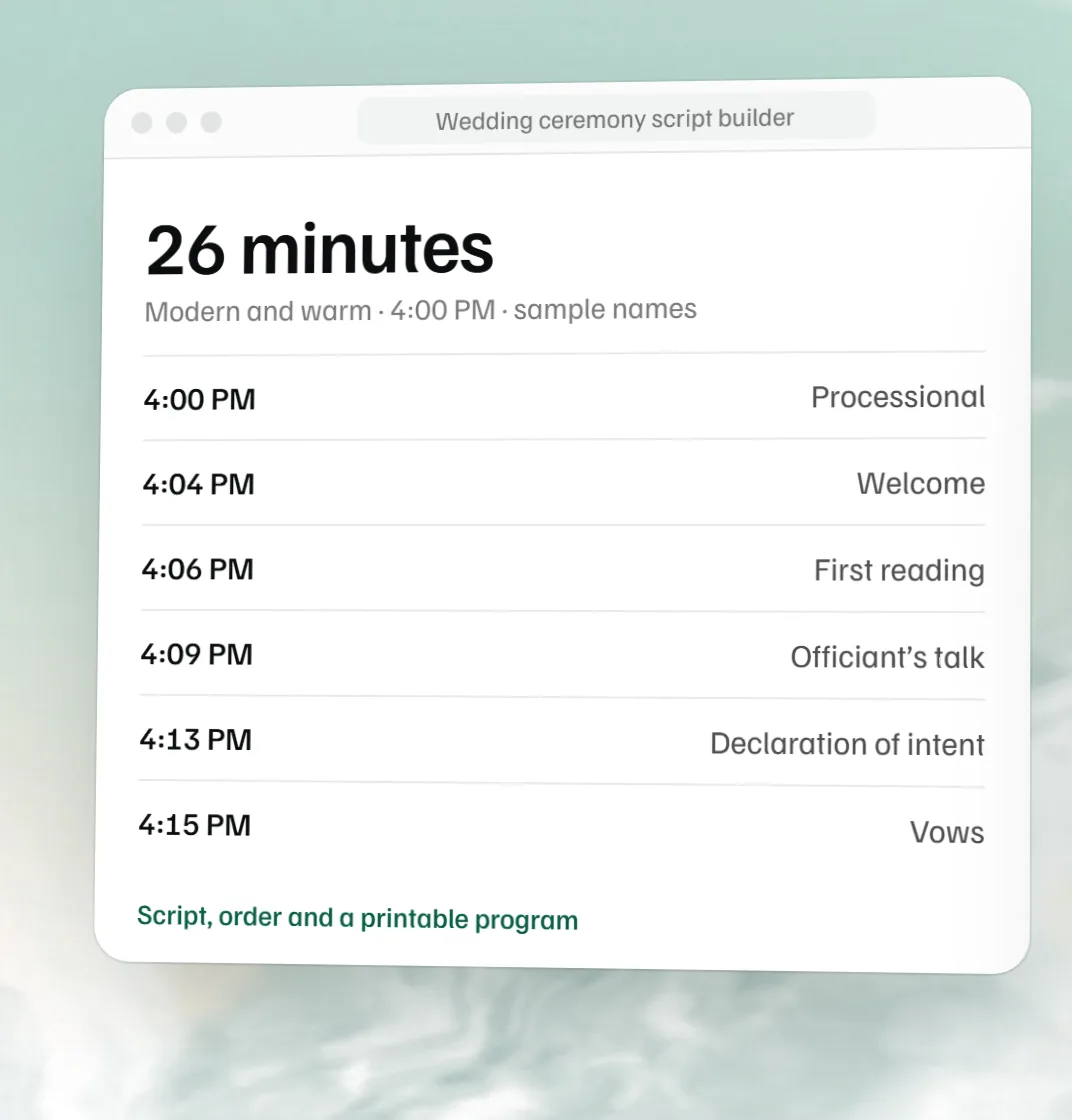
The order of a wedding ceremony, and what each part is for
The builder uses the common American order, which is a custom and not a rule. The minutes are its defaults for the modern and warm script; change any of them in the tool.
- Prelude and seating, 20 minutes before the start. Music while guests find seats. Seat parents and grandparents last; their arrival tells the room it is about to begin.
- Processional, 4 minutes. Everyone into place. Walk your own aisle once at the speed of the song, because a long aisle adds minutes no template knows.
- Welcome, 2 minutes. The officiant says who they are and why everyone is here, and can ask for phones away.
- Family and guests, 2 minutes. A thank-you to the people who raised and carried you here. Off in the modern script; cut it first when time is tight.
- First reading, 3 minutes. A friend or relative reads something you chose, which rests the officiant’s voice.
- Officiant’s talk, 4 minutes. The part that sounds like you. Ask for two short stories, not a speech; it swings the total most.
- Declaration of intent, 2 minutes. Each of you answers a question saying you are marrying freely. The exact words can matter legally, so see the section on what must be said.
- Vows, 4 minutes. The promises, read from your own cards or repeated after the officiant.
- Ring exchange, 2 minutes. One person holds both rings and checks for them before the processional.
- Unity ritual, 4 to 5 minutes. Optional. Lighting, pouring or tying something together. One at most.
- Pronouncement and kiss, 1 minute. The officiant declares the marriage and you kiss. Confirm their wording with the county clerk.
- Introduction as a married couple, 1 minute. Guests meet you as a married couple. The cue to cheer and start the recessional music.
- Recessional, 3 minutes. The exit, and the cue for where guests go next. Say the cocktail hour directions aloud.
Traditional, modern, non-religious or short: which script?
Traditional is formal. It thanks the families, asks the guests to support the marriage and has you repeat vows after the officiant. Modern and warm speaks plainly, allows a joke and expects each of you to read your own vows.
Non-religious leaves out faith language and puts the weight on choice, witnesses and the promises, which is what people mean by a secular ceremony script. Short is the simple wedding ceremony script: about ten minutes, for a small wedding or an elopement.
A faith ceremony, Catholic, Jewish, Muslim, Hindu or another tradition, follows the officiant’s own book, so ask for their order of service and use the Order tab only for timing. The light spiritual switch adds a moment of quiet and a short blessing to a traditional or modern script. It is not a rite.
How long does a wedding ceremony take?
From the first step of the processional to the end of the recessional, the four scripts come to the totals below. The prelude plays before the start, so it is not counted. These are the rule of thumb we use, one number per part; they are not a survey of real weddings, and every one can be changed in the tool.
| Style | Minutes |
|---|---|
| Traditional | 30 |
| Modern and warm | 26 |
| Non-religious | 28 |
| Short, about ten minutes | 10 |
Two things move the number more than any switch. The officiant’s talk stretches to fill whatever it is given, so agree a length with them. The aisle matters too, since the processional minutes assume an ordinary one; time yours by walking it at the speed of the music. Here is what changing one thing does to the modern and warm total.
| Change | Minutes |
|---|---|
| Add a sand ceremony | +5 |
| Add handfasting | +5 |
| Add a unity candle | +4 |
| Add a second reading | +3 |
| Add a family and guests moment | +2 |
| Repeat-after-me vows instead of personal | −1 |
| Drop the introduction | −1 |
| Skip the processional’s wedding party | −2 |
| Drop the reading | −3 |
The ceremony length is also what pushes the rest of the day. Seat guests 20 minutes before the start, add the total, and the cocktail hour cannot begin until the last guest has left the room.
How to write a wedding ceremony script from scratch
- Ask the county clerk first. Who may officiate and what must be said can change the wording and even the officiant, so find out before you write a line.
- Pick the length, then the parts. Start from the short version and add a reading or a ritual only if you will miss it.
- Collect two stories before you write. How you met, and one moment you knew. The talk is those two stories joined by a few lines about what you believe a marriage asks of people.
- Write the vows on their own. They are the one part that is not the officiant’s, so keep them out of the script until they are done.
- Mark who speaks. Put stage directions in brackets, such as [Priya reads], so the officiant knows when to hand off and when to wait.
- Read it aloud and time it. The builder counts about 130 spoken words a minute; people slow down when they are moved.
- Print two copies. One for the officiant and one for the coordinator, with the start time at the top.
Personal vows or traditional vows?
Repeated vows ask for no memory and no nerve: the officiant says a phrase and you say it back. They take two or three minutes for both of you and they cannot go wrong. Personal vows are the part guests remember, and they take longer, need an agreed length and ask you to read in front of people.
A middle path works well. Read short personal vows, then repeat one shared promise as you exchange rings. Repeated vows suit a couple who dreads speaking, and everyone in the room knows the words.
For a wedding vows template, use the Vows helper tab. It splits a vow into what you see in your partner, what you promise and what you look forward to, with prompts for each. It does not write them for you.
What goes in a wedding ceremony program
The names, the date and the venue, the time the ceremony begins, and the order of the ceremony in plain words. After that, the wedding party with their roles, the officiant, and who reads. A line of thanks at the foot is usual, and so is a line saying where the cocktail hour is.
The Program tab builds that on one page and prints only the page. If you print a reading in the program, check whether it is still under copyright first. Leave out the times of the individual parts; a program that promises a four minute talk gets argued with.
What has to be said for the wedding to be legal?
We cannot tell you, and neither can any script. In most places a legal wedding involves a license, someone allowed to officiate and sometimes witnesses and a few required words, but what counts changes from state to state. Ask your officiant and the county clerk where you are marrying.
That is why the builder marks the declaration of intent and the pronouncement as the parts to confirm. Use our wording as a draft, and put in theirs wherever it differs. Nothing on this page is legal advice.
For venues and coordinators
Send this page to couples before the rehearsal. They arrive with an order, a start time and a length, and the rehearsal becomes a walk-through of something already decided instead of a negotiation. A note you can paste:
Before our rehearsal, please build your ceremony order at myvenuehq.com/free-wedding-ceremony-script-builder and send me the Word file or the printout. I need the start time, the length, how many chairs you want and where your officiant will stand.
The ceremony length sets the cocktail hour. The caterer and the bar are waiting on the last recessional step, so a ceremony that runs twelve minutes past its estimate starts the cocktail hour twelve minutes late and leaves the hot trays on the line. Take the end time from the Order tab and the wedding timeline template carries it through the rest of the day.
The things a script cannot carry belong on the floor plan: the chair count and aisle width, where the officiant stands and which way they face, where the readers stand, the table for a unity ritual and the officiant’s microphone.
In MyVenueHQ the ceremony time, the room setup and the BEO sit on one event, so the coordinator, the caterer and the bar read the same start time. Start free.
Add this wedding ceremony script builder to your website
Venues, planners and wedding blogs can put it on their own site for free. Paste this where you want it; it works in WordPress, Squarespace, Wix and plain HTML. Nothing is tracked about your visitors beyond page views.
Ceremony questions.
How long is a wedding ceremony?
With one reading, personal vows and no ritual, the modern and warm script runs 26 minutes from the processional to the end of the recessional. The traditional script runs 30, the non-religious one 28 and the short one 10. These are the rule of thumb we use, not a measured average, and you can change every part’s minutes. A religious service can run well past an hour.
Who walks in what order at a wedding ceremony?
Usually the officiant is in place first and the parents and grandparents are seated. The wedding party walks in, often in pairs with the maid of honor and best man last, then the ring bearer and flower girl, then the couple, together or one after the other. The recessional runs the other way: the couple, then the wedding party, then the families. It is a custom, not a rule.
Do we need a rehearsal?
No law asks for one. A walk-through helps when there is a wedding party or an aisle to time, because it fixes who stands where and who holds the rings. For a small ceremony, ten minutes at the spot with the officiant is enough. Ask your venue whether a rehearsal slot comes with the booking.
Can a friend officiate our wedding?
Often, but who may legally officiate depends on the state. Some places accept a friend ordained online or authorized for the day, some do not, and a few let a couple marry without an officiant. Ask the county clerk where you will marry who counts, before you ask your friend.
What has to be said for a wedding to be legal?
It varies by state and by who officiates, so we cannot tell you, and no script can. In most places a legal wedding involves a license, someone allowed to officiate and sometimes witnesses and a few required words. Ask your officiant and the county clerk. The builder marks the declaration of intent and the pronouncement as the parts to confirm; swap in their wording where it differs.
How do we include a unity ritual?
Pick one and put it after the rings and before the pronouncement. The builder has a unity candle, a sand ceremony, handfasting and a wine and letters box, at 4 to 5 minutes each. Ask your venue first if it involves flame, sand or liquid, practice it once, and plan for wind outdoors.
Is there a short wedding ceremony script for a small wedding?
Yes. Choose Short above: a processional, a welcome, a one-minute talk, the declaration of intent, vows, rings and the pronouncement, 10 minutes in all. It suits a small wedding or an elopement, and you can switch on a reading or a ritual if you have a few more minutes.
Is the script builder free?
Yes. The script, order, program and vows helper work with no account, and you can copy, print or download them as Word. What you type stays in your browser.
Related free tools
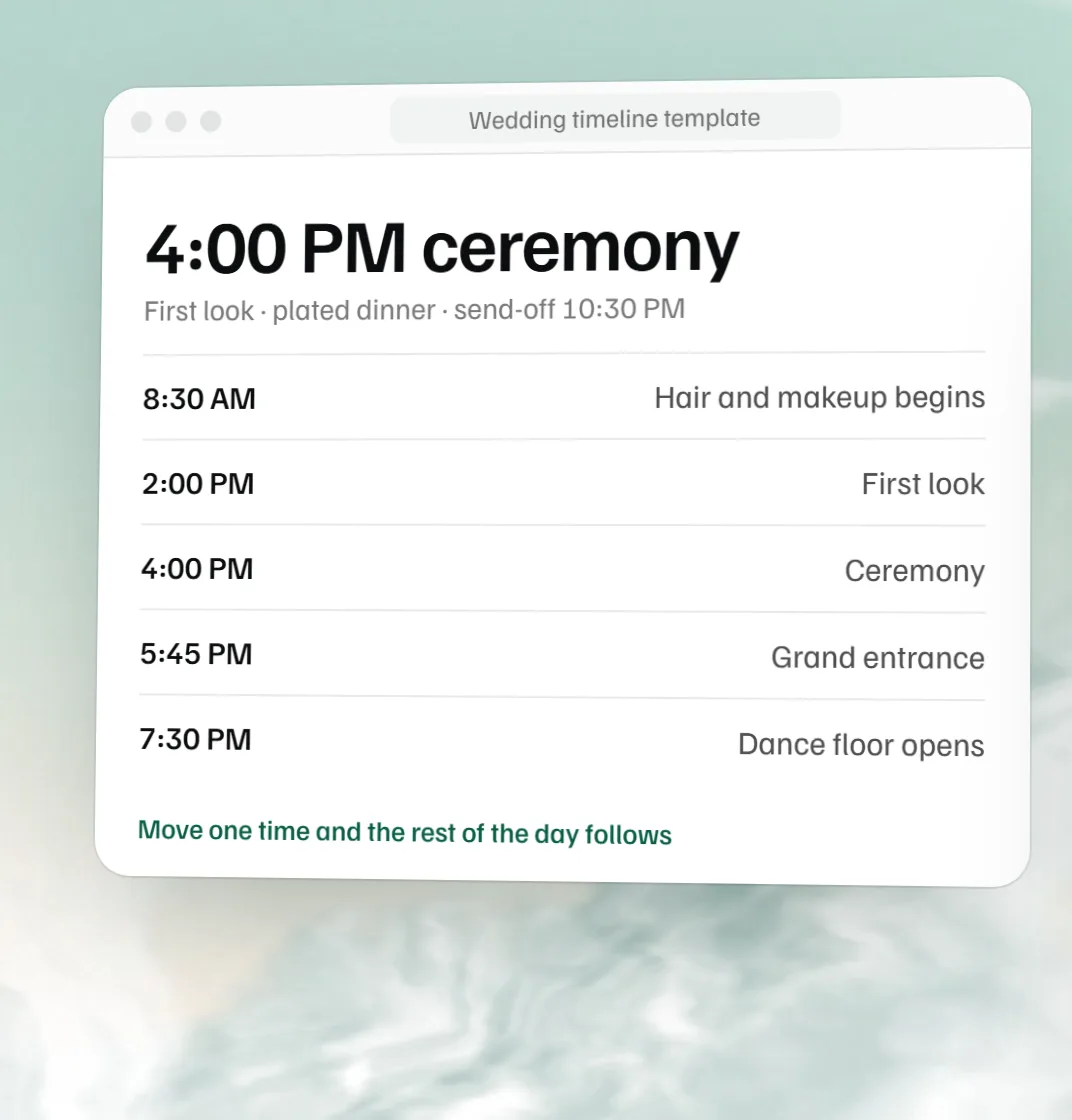 Free wedding timeline template The wedding day hour by hour, built from the ceremony time.
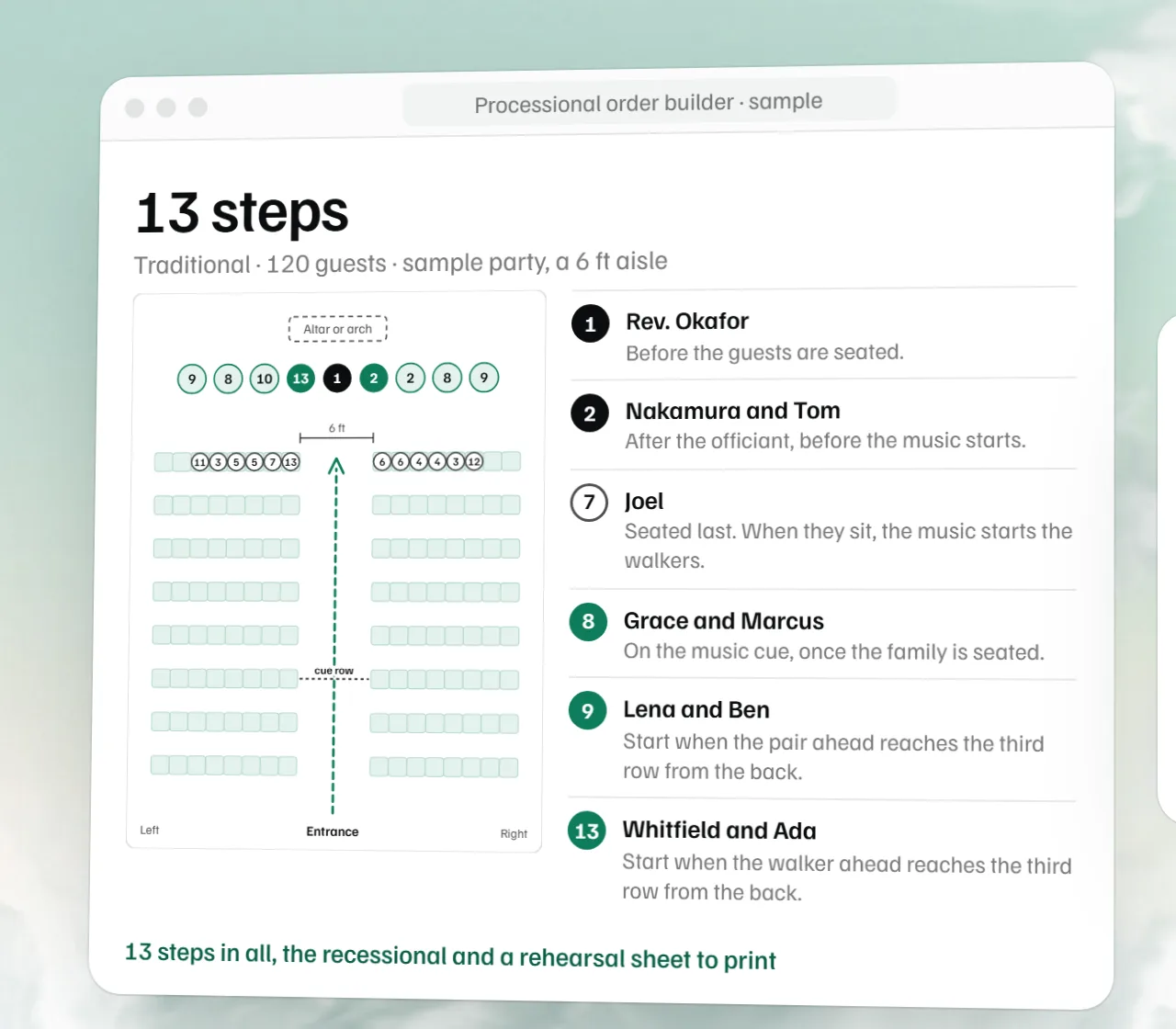 Free wedding processional order builder The ceremony order for your party, the recessional, an aisle diagram and a rehearsal sheet.
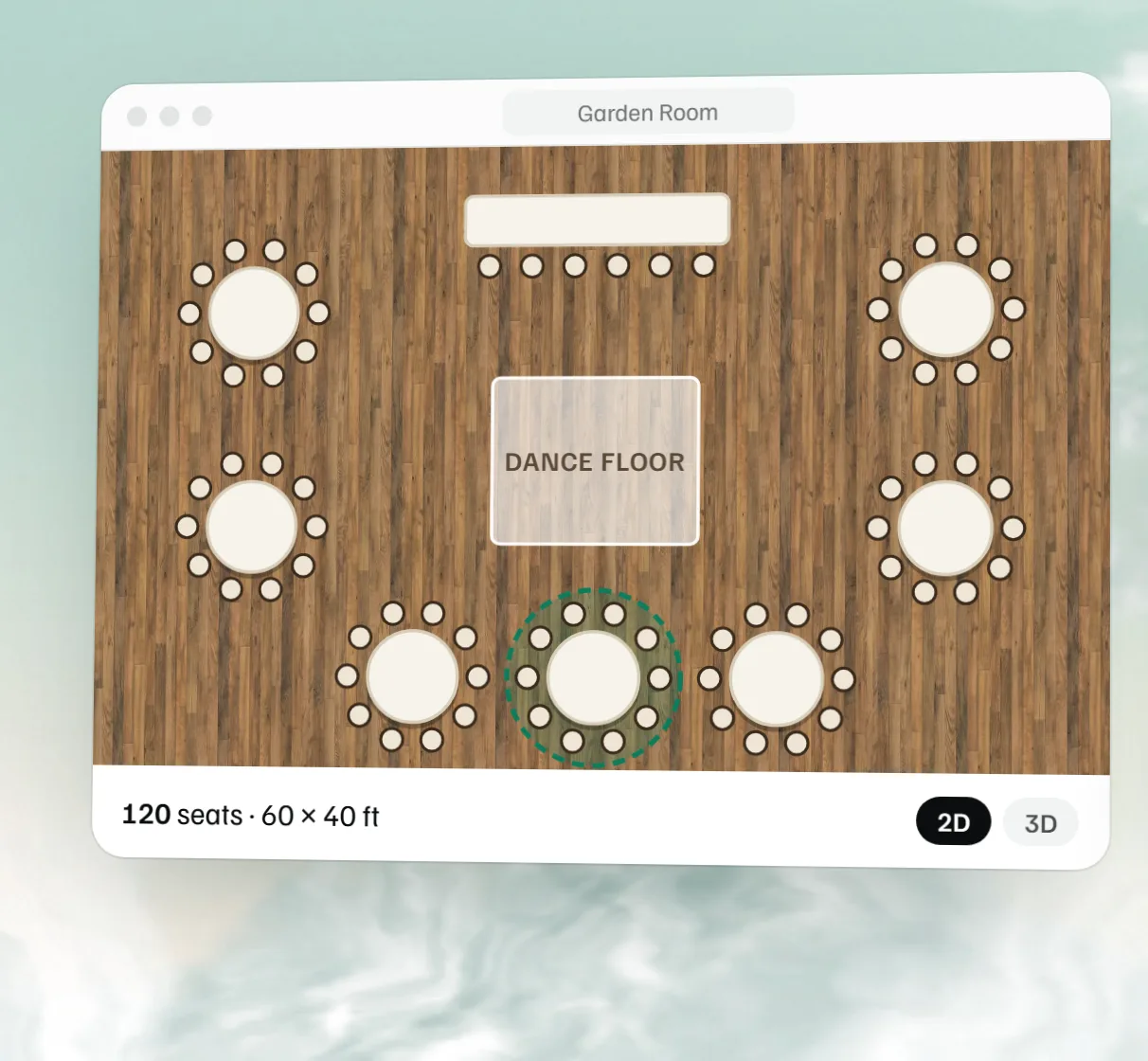 Free event floor plan maker Draw the room to scale with tables, stage, bar and dance floor, then see it in 3D.
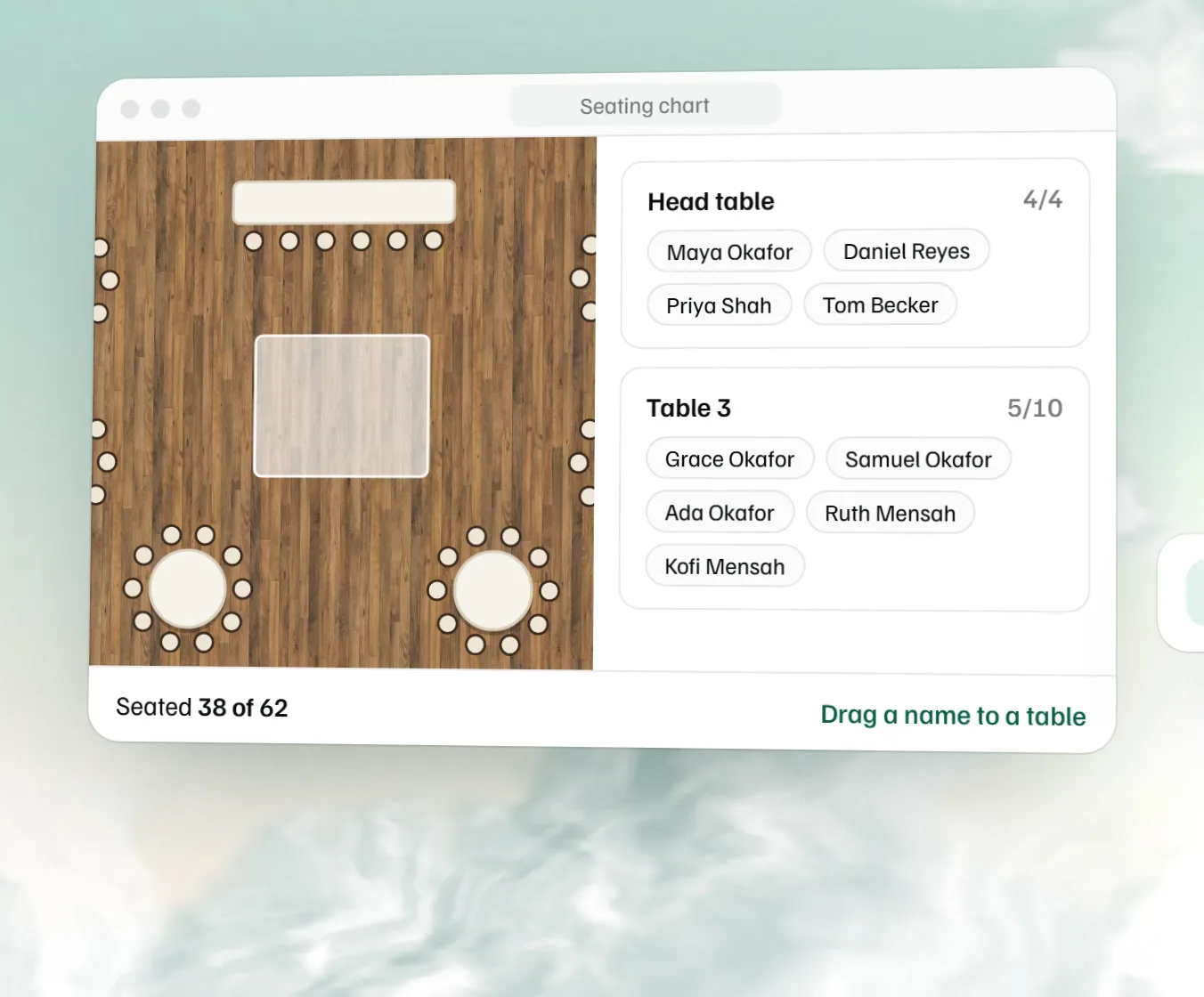 Free seating chart maker Paste the guest list, drag names to numbered tables and download the chart.