Free wedding processional order builder
The traditional wedding processional order is the officiant, the groom and best man, grandparents, parents, bridesmaids and groomsmen in pairs, the maid of honor, the ring bearer and flower girl, and last the bride with her escort.
The recessional runs the other way, couple first and wedding party behind; the order varies by tradition, venue and couple, and your officiant has the final say.
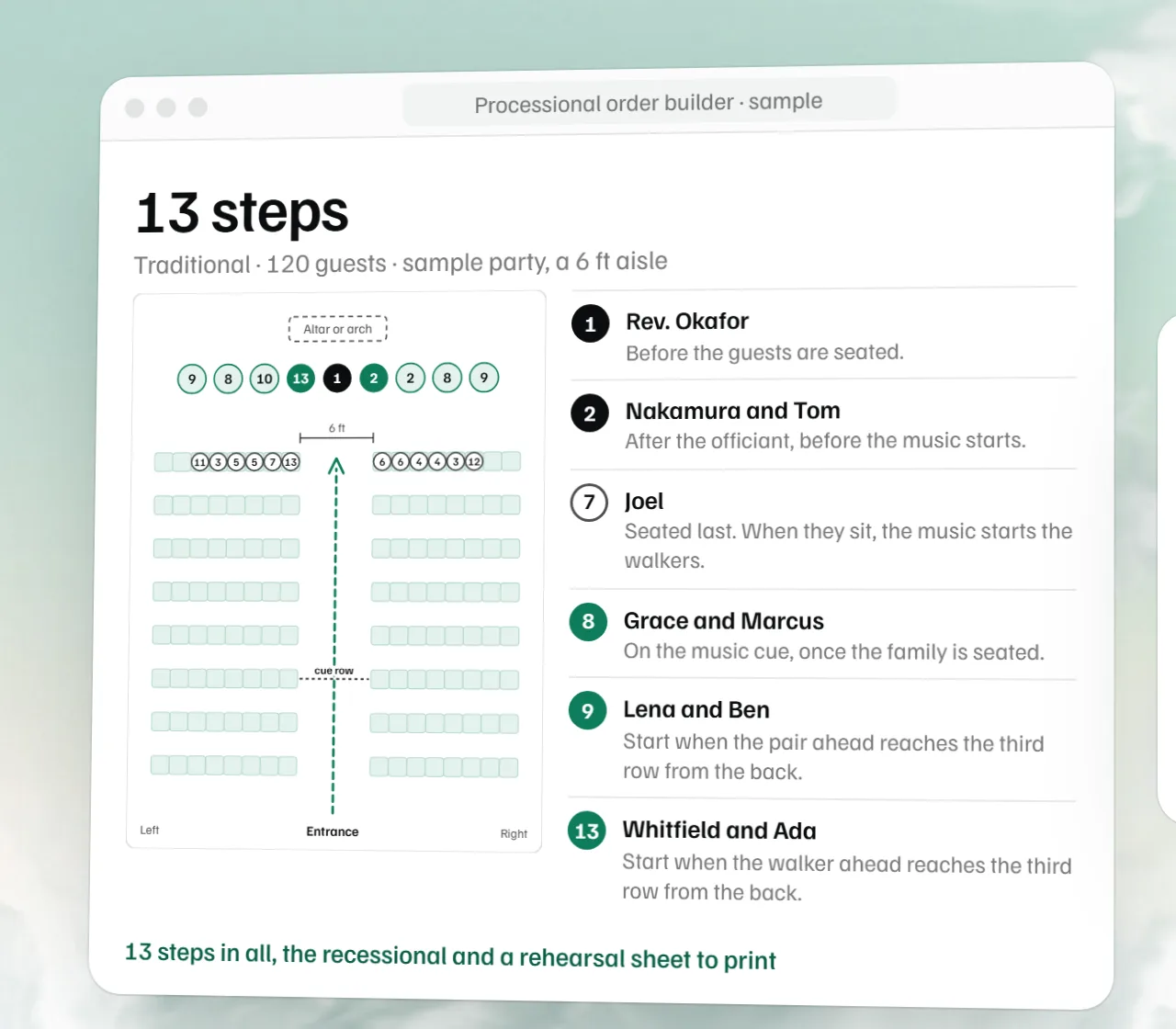
13 steps
In the processional: 21 people, 9 of them walking down the aisle. Traditional, 80 guests.
Processional
Left and right are as you see them walking in from the back.
Officiant In place
Takes their place at the front, in the middle, facing the guests.
Cue Before the guests are seated.
Partner 2 with Partner 2's honor attendant In place
Come in from the side and stand on the right of the officiant, facing the guests.
Cue After the officiant, before the music starts.
Readers (2) Seated
Sit near the front, on the aisle, so they can reach the front quickly.
Cue Before the music starts.
Partner 2's grandparents (2) Seated
Are escorted to the front row on the right by an usher or a family member.
Cue Before the music starts.
Partner 1's grandparents (2) Seated
Are escorted to the front row on the left by an usher or a family member.
Cue Before the music starts.
Partner 2's parents (2) Seated
Are escorted to the front row on the right.
Cue Before the music starts.
Partner 1's parent 2 Seated
Is escorted to the front row on the left.
Cue Seated last. When they sit, the music starts the walkers.
Partner 1's attendant 1 with Partner 2's attendant 1 Walks
Walk in together, then split: Partner 1's attendant 1 goes to the left, Partner 2's attendant 1 to the right.
Cue On the music cue, once the family is seated.
Partner 1's attendant 2 with Partner 2's attendant 2 Walks
Walk in together, then split: Partner 1's attendant 2 goes to the left, Partner 2's attendant 2 to the right.
Cue Start when the pair ahead reaches the third row from the back.
Partner 1's honor attendant Walks
Walks in alone and goes to the left.
Cue Start when the pair ahead reaches the third row from the back.
Ring bearer Walks
Walks down the aisle, then goes to a seat in the front row with a family member.
Cue Start when the walker ahead reaches the third row from the back.
Child attendant Walks
Walks down the aisle, then goes to a seat in the front row with a family member.
Cue Start when the walker ahead reaches the third row from the back.
Partner 1 with Partner 1's parent 1 Walks
Walk down the aisle together. Partner 1's parent 1 then sits in the front row on the left, and Partner 1 joins the officiant.
Cue Start when the walker ahead reaches the third row from the back.
Recessional
Left and right are as you see them walking in from the back.
Partner 1 with Partner 2 Walks
Walk out together.
Cue On the music cue, after the officiant ends the ceremony.
Child attendant Walks
Leaves from the front row behind the couple, with a family member.
Cue Start when the pair ahead reaches the third row from the front.
Ring bearer Walks
Leaves from the front row behind the couple, with a family member.
Cue Start when the walker ahead reaches the third row from the front.
Partner 1's honor attendant with Partner 2's honor attendant Walks
Walk out together.
Cue Start when the walker ahead reaches the third row from the front.
Partner 1's attendant 2 with Partner 2's attendant 2 Walks
Walk out together, in the pairs they walked in.
Cue Start when the pair ahead reaches the third row from the front.
Partner 1's attendant 1 with Partner 2's attendant 1 Walks
Walk out together, in the pairs they walked in.
Cue Start when the pair ahead reaches the third row from the front.
Officiant Walks
Follows the wedding party out, or waits at the front until the aisle is clear. The officiant decides.
Cue After the wedding party has passed.
Partner 1's parents (2) Walks
Step out of the front row on the left once the wedding party has passed, and follow it out.
Cue Once the wedding party has passed your row.
Partner 2's parents (2) Walks
Step out of the front row on the right once the wedding party has passed, and follow it out.
Cue Once the wedding party has passed your row.
Partner 1's grandparents (2) Walks
Follow the parents out from the left, with an usher or a family member if they would like one.
Cue After the parents.
Partner 2's grandparents (2) Walks
Follow the parents out from the right, with an usher or a family member if they would like one.
Cue After the parents.
Guests, with Readers (2) Walks
Leave row by row from the front, with the readers in their rows.
Cue On the usher's or officiant's cue.
Diagram
- Officiant
- The couple
- Wedding party, standing at the front
- Family, readers and children, seated
84 chairs in 7 rows of 12, with a 6 ft aisle. The seating block is 588 sq ft, 7 sq ft a chair. Our capacity calculator uses 6 to 8 sq ft a guest for rows of chairs, so 80 guests is 480 to 640 sq ft for the whole room. Chairs are 18 inches wide with rows 24 inches apart, the sizes our floor plan maker uses. The space at the front and back is a drawing choice.
Ceremony processional and rehearsal sheet
| Done | # | Who | What | Cue |
|---|---|---|---|---|
| 1 | Officiant | Takes their place at the front, in the middle, facing the guests. | Before the guests are seated. | |
| 2 | Partner 2with Partner 2's honor attendant | Come in from the side and stand on the right of the officiant, facing the guests. | After the officiant, before the music starts. | |
| 3 | Readers (2) | Sit near the front, on the aisle, so they can reach the front quickly. | Before the music starts. | |
| 4 | Partner 2's grandparents (2) | Are escorted to the front row on the right by an usher or a family member. | Before the music starts. | |
| 5 | Partner 1's grandparents (2) | Are escorted to the front row on the left by an usher or a family member. | Before the music starts. | |
| 6 | Partner 2's parents (2) | Are escorted to the front row on the right. | Before the music starts. | |
| 7 | Partner 1's parent 2 | Is escorted to the front row on the left. | Seated last. When they sit, the music starts the walkers. | |
| 8 | Partner 1's attendant 1with Partner 2's attendant 1 | Walk in together, then split: Partner 1's attendant 1 goes to the left, Partner 2's attendant 1 to the right. | On the music cue, once the family is seated. | |
| 9 | Partner 1's attendant 2with Partner 2's attendant 2 | Walk in together, then split: Partner 1's attendant 2 goes to the left, Partner 2's attendant 2 to the right. | Start when the pair ahead reaches the third row from the back. | |
| 10 | Partner 1's honor attendant | Walks in alone and goes to the left. | Start when the pair ahead reaches the third row from the back. | |
| 11 | Ring bearer | Walks down the aisle, then goes to a seat in the front row with a family member. | Start when the walker ahead reaches the third row from the back. | |
| 12 | Child attendant | Walks down the aisle, then goes to a seat in the front row with a family member. | Start when the walker ahead reaches the third row from the back. | |
| 13 | Partner 1with Partner 1's parent 1 | Walk down the aisle together. Partner 1's parent 1 then sits in the front row on the left, and Partner 1 joins the officiant. | Start when the walker ahead reaches the third row from the back. |
| Done | # | Who | What | Cue |
|---|---|---|---|---|
| 1 | Partner 1with Partner 2 | Walk out together. | On the music cue, after the officiant ends the ceremony. | |
| 2 | Child attendant | Leaves from the front row behind the couple, with a family member. | Start when the pair ahead reaches the third row from the front. | |
| 3 | Ring bearer | Leaves from the front row behind the couple, with a family member. | Start when the walker ahead reaches the third row from the front. | |
| 4 | Partner 1's honor attendantwith Partner 2's honor attendant | Walk out together. | Start when the walker ahead reaches the third row from the front. | |
| 5 | Partner 1's attendant 2with Partner 2's attendant 2 | Walk out together, in the pairs they walked in. | Start when the pair ahead reaches the third row from the front. | |
| 6 | Partner 1's attendant 1with Partner 2's attendant 1 | Walk out together, in the pairs they walked in. | Start when the pair ahead reaches the third row from the front. | |
| 7 | Officiant | Follows the wedding party out, or waits at the front until the aisle is clear. The officiant decides. | After the wedding party has passed. | |
| 8 | Partner 1's parents (2) | Step out of the front row on the left once the wedding party has passed, and follow it out. | Once the wedding party has passed your row. | |
| 9 | Partner 2's parents (2) | Step out of the front row on the right once the wedding party has passed, and follow it out. | Once the wedding party has passed your row. | |
| 10 | Partner 1's grandparents (2) | Follow the parents out from the left, with an usher or a family member if they would like one. | After the parents. | |
| 11 | Partner 2's grandparents (2) | Follow the parents out from the right, with an usher or a family member if they would like one. | After the parents. | |
| 12 | Guests, with Readers (2) | Leave row by row from the front, with the readers in their rows. | On the usher's or officiant's cue. |
This order varies by tradition, venue and couple. Your officiant has the final say; faith ceremonies follow their own order.
Copying, printing and the Word file are free, with no account, and nothing you type leaves this page. This order varies by tradition, venue and couple; your officiant has the final say.
Wedding processional order by style
The builder makes four orders. Each table below is the order for that style with the builder's usual party, so you can see its shape before you change anything. Put your own counts into the tool and every step, cue and name follows; the tables here stay as a guide.
Traditional
The officiant and partner 2, with an honor attendant, are at the front before anyone walks. Readers, grandparents and parents are seated, partner 1's parents last. Then the attendants walk in pairs, the honor attendant after them, then the children, and partner 1 last with an escort.
| Step | Who | What they do |
|---|---|---|
| 1 | Officiant | Takes their place at the front |
| 2 | Partner 2 and their honor attendant | Wait at the front |
| 3 | Readers | Seated near the front, on the aisle |
| 4 | Grandparents | Seated by an usher or a family member |
| 5 | Parents of partner 2 | Seated by an usher or a family member |
| 6 | Parents of partner 1 | Seated last, which starts the music |
| 7 | Attendants | 2 pairs, walking in together |
| 8 | Honor attendant | Walks alone |
| 9 | Ring bearer | Walks in, then sits with a family member |
| 10 | Child attendant | Walks in, then sits with a family member |
| 11 | Partner 1 | Walks with a parent |
Modern, both partners walk
Both partners walk down the aisle, partner 2 first and partner 1 last, each alone or with an escort. The honor attendants walk in together. To change who goes first, swap the two names in the tool.
| Step | Who | What they do |
|---|---|---|
| 1 | Officiant | Takes their place at the front |
| 2 | Readers | Seated near the front, on the aisle |
| 3 | Grandparents | Seated by an usher or a family member |
| 4 | Parents of partner 2 | Seated by an usher or a family member |
| 5 | Parents of partner 1 | Seated last, which starts the music |
| 6 | Attendants | 2 pairs, walking in together |
| 7 | Honor attendants | Walk in together |
| 8 | Ring bearer | Walks in, then sits with a family member |
| 9 | Child attendant | Walks in, then sits with a family member |
| 10 | Partner 2 | Walks alone |
| 11 | Partner 1 | Walks alone |
Both partners with their parents
Each partner walks between both parents, who then sit in the front row. Because the parents arrive with their child, only the grandparents and the readers are seated beforehand.
| Step | Who | What they do |
|---|---|---|
| 1 | Officiant | Takes their place at the front |
| 2 | Readers | Seated near the front, on the aisle |
| 3 | Grandparents | Seated by an usher or a family member |
| 4 | Attendants | 2 pairs, walking in together |
| 5 | Honor attendants | Walk in together |
| 6 | Ring bearer | Walks in, then sits with a family member |
| 7 | Child attendant | Walks in, then sits with a family member |
| 8 | Partner 2 | Walks with both parents |
| 9 | Partner 1 | Walks with both parents |
Small ceremony, under 30 guests
The family is already seated, so nobody needs an usher. Any attendants walk in, then the partners walk in together. A room for 24 guests has about 4 rows, so the spacing cue is short.
| Step | Who | What they do |
|---|---|---|
| 1 | Officiant | Takes their place at the front |
| 2 | Readers | Seated near the front, on the aisle |
| 3 | Parents of partner 2 | Seated by an usher or a family member |
| 4 | Parents of partner 1 | Seated last, which starts the music |
| 5 | Honor attendants | Walk in together |
| 6 | Both partners | Walk in together |
Faith ceremonies have their own order
Jewish, Catholic and many other ceremonies have a processional of their own, with roles, positions and customs this builder does not know. If you are marrying in one, take the order from your officiant. The aisle diagram and the spacing rule can still help you plan the room.
The same goes for a family or cultural custom you want to keep. Tell the officiant, then put it into the rehearsal. The four styles here are starting points, and none of them is a rule of etiquette.
Wedding recessional order
The recessional is mostly the processional run backwards. The couple go first, together. The children and the honor attendants follow, then the attendants in the pairs they came in with, and the pair that walked in last goes out first. The officiant either follows the wedding party or waits at the front, which is theirs to decide. Parents step out of the front row once the party has passed, grandparents after them, and the guests last, row by row from the front.
| Step | Who | What they do |
|---|---|---|
| 1 | Both partners | Walk out together |
| 2 | Child attendant | Leaves with a family member |
| 3 | Ring bearer | Leaves with a family member |
| 4 | Honor attendants | Walk out together |
| 5 | Attendants | 2 pairs, walking out together |
| 6 | Officiant | Follows the wedding party, or waits. The officiant decides |
| 7 | Parents of partner 1 | Step out and follow the party |
| 8 | Parents of partner 2 | Step out and follow the party |
| 9 | Grandparents | Follow the parents out |
| 10 | Guests and readers | Leave row by row from the front |
Some couples have the parents leave with the wedding party, or the children leave with their own parents. Both work. Say which at the rehearsal so the ushers know; the tool puts the family behind the wedding party.
Who walks with whom, and why the order exists
Most of the order is practical. Family is seated first so nobody is still looking for a chair when the music starts, and the last parent to sit is the cue for the walkers. Attendants go in pairs so that two people arrive at the front together and then split, which leaves an even line on both sides. When one side has more attendants than the other, the extras walk alone after the pairs.
The honor attendants come late because they stand next to the couple, and in many ceremonies they hold the rings or the bouquet. The children walk just before the partners. Their walk is short and the room is watching them. The partner who comes last is the one everybody is waiting for.
The escort is whoever the partner chooses: a parent, both parents, a sibling, a grandparent, a child, a friend, or nobody. Afterwards the escort sits in the front row. Some orders have the officiant ask the escort a question at the front. If you want that in or out, tell your officiant.
| Who | Walks with | After the walk |
|---|---|---|
| Attendants | An attendant from the other side, by position | Split, one to each side of the couple |
| Honor attendants | Each other, or alone | Stand next to their partner |
| Ring bearers and child attendants | Each other, or alone | Sit in the front row with a family member |
| A partner who walks | Alone, one parent, both parents or a person they choose | Joins the officiant; the escort sits in the front row |
| Grandparents who walk | Each other, as couples | Sit in the front row |
How far apart should wedding processional walkers be?
We use one rule: the next walkers start when the ones ahead reach the third row from the back. It is our rule, not a standard, and the tool lets you change the row. It counts in rows because rows are what everybody can see, at the rehearsal and on the day.
In the sample layout the rows are 42 inches apart: an 18 inch chair plus 24 inches, the sizes our floor plan maker uses. So the row you pick works out to a rough distance, counting from the row where the walkers start:
| Next walkers start when the ones ahead reach row | They are about this far ahead |
|---|---|
| 2 | 3.5 ft |
| 3 (our default) | 7 ft |
| 4 | 10.5 ft |
| 5 | 14 ft |
| 6 | 17.5 ft |
A short aisle wants a smaller number: in a room with four rows, starting at the second keeps the line moving. A long aisle can take a larger one. The tool never lets the cue go past the last row of your room. Walk it once with the music at the rehearsal, because people walk to the pace of the song, and change the number if the line bunches up or opens a gap.
Special cases: divorced parents, no attendants, children, pets and wheelchairs
Divorced parents
Nobody has to walk together or sit together. A partner can walk with one parent, with both, or with someone else, and the other parent sits in the front row on that side. If two households need some distance, tell the ushers where to seat each one, and tell the photographer.
A parent who has died, or no parent in the picture
Walk alone, with someone you choose, or with the parent who is there. Some people keep a seat in the front row with a flower or a photograph on it. Ask the officiant if you would like it mentioned. Any of these is an ordinary choice.
No attendants
Set the attendant counts to 0. The order loses those steps and nothing else changes; the small ceremony style starts with none. A friend or sibling who stands with you but does not walk can wait at the front with the officiant, the way partner 2 and their honor attendant do in the traditional style.
Children
If a child will not go alone, let them walk with a sibling or an adult, and plan for a family member to sit with them afterwards. Practice with the real music at the rehearsal. If a child freezes on the day, an adult can walk out and collect them. Decide who that is beforehand.
Pets
Ask the venue first, because many do not allow animals indoors or near food. If a pet walks, give it a handler who is not in the wedding party. Enter the pet and handler as a child attendant, since they do what one does: walk in, sit with a family member, leave with them.
Wheelchair users and mobility aids
Ask the person how they would like to do it before anyone else decides. The aisle in the diagram is 6 ft wide, enough for a person and an escort side by side; measure yours, and check the route from the door to the front for steps and thresholds. Put the space for a chair at the end of a row, on the aisle. A grandparent with a cane or walker is easiest to seat early, in the front row on the aisle.
The rehearsal in 20 minutes
Print the rehearsal sheet and give a copy to the officiant, the coordinator and whoever runs the music. This is the split we use. Change it to suit your party; a big one, or children who need practice, will take longer.
- 0 to 3 minutes. Everyone together. The officiant says how the ceremony runs, in order, and hands out the sheet.
- 3 to 8 minutes. Positions at the front. Walk each person to the spot where they will stand, with the couple in the middle.
- 8 to 16 minutes. The walk. The walkers do the processional twice, first without music and then with it, using the cue row on the sheet. Escorts sit as soon as they arrive.
- 16 to 19 minutes. The recessional, once.
- 19 to 20 minutes. Cues. Settle who tells the music to start, who sends the ushers, and who gets the guests out.
For venues and coordinators
Five facts about your ceremony space decide most of a rehearsal: how long the aisle is, how wide it is, how many chairs there are, where the officiant stands and where the music cue comes from. Put all five on the floor plan and send it to the couple with their rehearsal time. Drawn on the aisle, the spacing question is easier to answer.
The diagram above is a sample, drawn with the same chair, row and aisle sizes as our free floor plan maker. Draw your own room there at its real size, with the ceremony chairs and the aisle, and the chair and row sizes will match the ones on this page. The capacity calculator shows how many chairs the room holds in rows.
Ask the couple for their officiant's order early if the ceremony is a faith one, and send the printed sheet to the officiant, the DJ and the ushers. The words that go with the walk, the officiant’s script and the printed program, come out of our free wedding ceremony script builder. MyVenueHQ keeps the ceremony time, the room setup and the BEO on one event.
Add this wedding processional order builder to your website
Venues, planners and wedding blogs can put it on their own site for free. Paste this where you want it; it works in WordPress, Squarespace, Wix and plain HTML. Nothing is tracked about your visitors beyond page views.
Processional questions.
Who walks down the aisle first at a wedding?
In the traditional order the officiant, the groom and the best man are already at the front, and the family is seated, so the first people to walk down the aisle are the attendants, in pairs. If the grandparents walk in, they go before the attendants. The bride comes last, with her escort. Orders differ by tradition, venue and couple, and your officiant has the final say.
What is the order of the bridal party in the processional?
Attendants walk in pairs, a bridesmaid with a groomsman, then the maid of honor, the ring bearer, the flower girl and last the bride with her escort. The best man comes in with the groom and waits at the front. If the two sides have different numbers, the extra attendants walk alone after the pairs. The builder above uses partner and attendant wording by default, and switches to bride, groom and bridesmaids if you pick that.
Do grandparents walk down the aisle?
They can, or they can be seated. In the builder the default is seated: an usher or a family member takes each grandparent to the front row before the music starts. Tick "Grandparents walk in" and they walk in as couples before the parents are seated. If a long walk is hard for a grandparent, seat them. Ask them which they prefer.
Who walks with the bride and groom?
In the traditional order the bride walks with her father, with both parents or with someone she chooses, and the groom comes in from the side with the best man. In the other styles each partner walks alone, with one parent, with both parents or with a person they choose, such as a sibling, a grandparent or a friend. After the walk the escort sits in the front row.
What is the recessional order?
The couple leave first, together. Children and the honor attendants follow, then the attendants in the pairs they came in with, last pair in going out first. The officiant follows the party or waits at the front, and parents, then grandparents, step out of the front row once the party has passed. Guests leave last, row by row from the front. The builder writes it out for your party in the Recessional tab.
How far apart should you walk down the aisle?
We use one rule: the next walkers start when the ones ahead reach the third row from the back. In our sample layout rows are 42 inches apart, so that puts the pair ahead about 7 feet in front of you. It is our rule, not a standard, and you can change the row in the tool. Rehearse it once with the music and adjust.
Can both partners walk down the aisle?
Yes. Pick the modern style and both partners walk, one after the other, each alone, with one parent, with both parents or with a person they choose. In the style with both partners and their parents, each partner walks between their own parents. Tell your officiant which you chose, so they know where each of you will be.
Related free tools
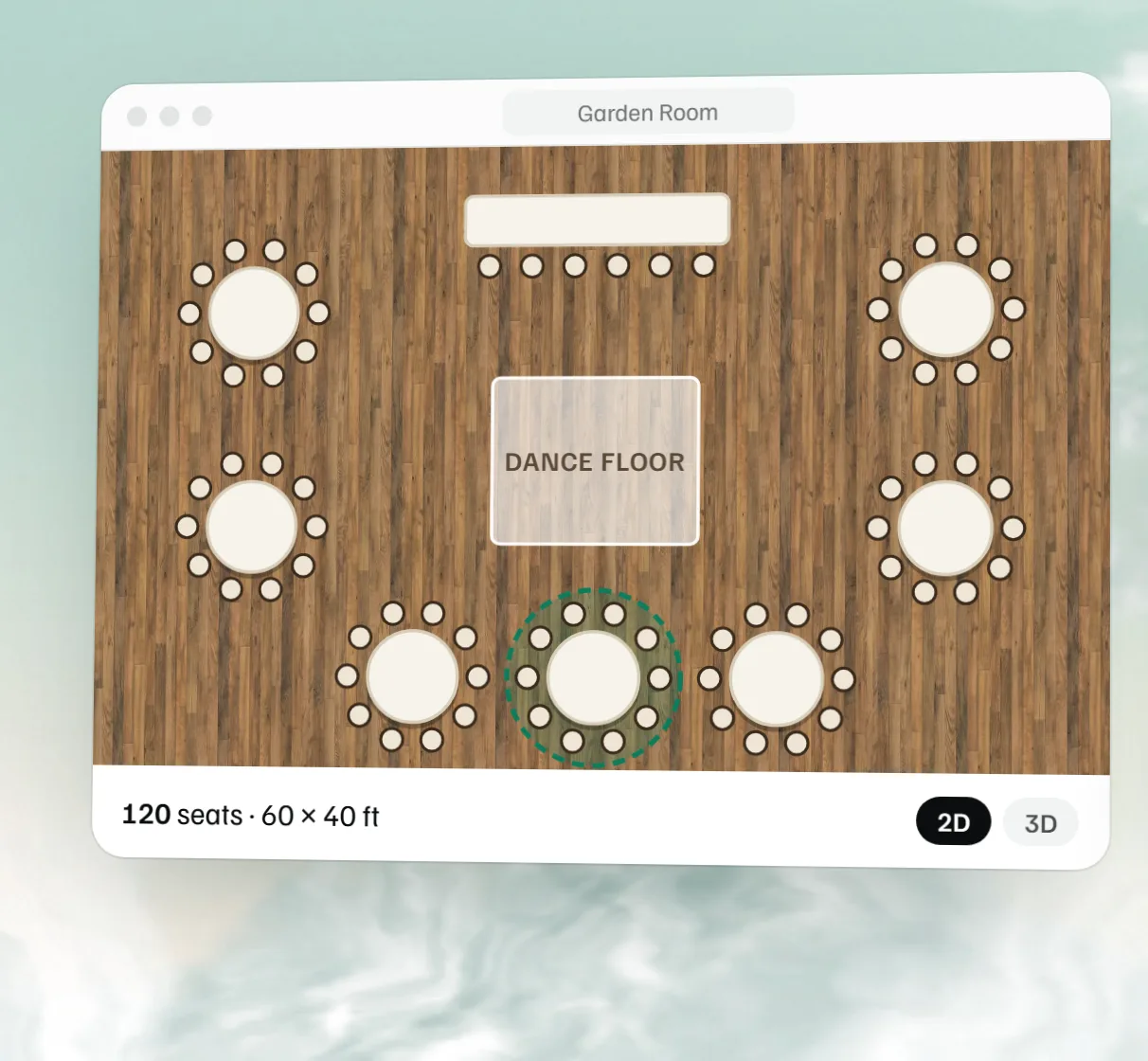 Free event floor plan maker Draw the room to scale with tables, stage, bar and dance floor, then see it in 3D.
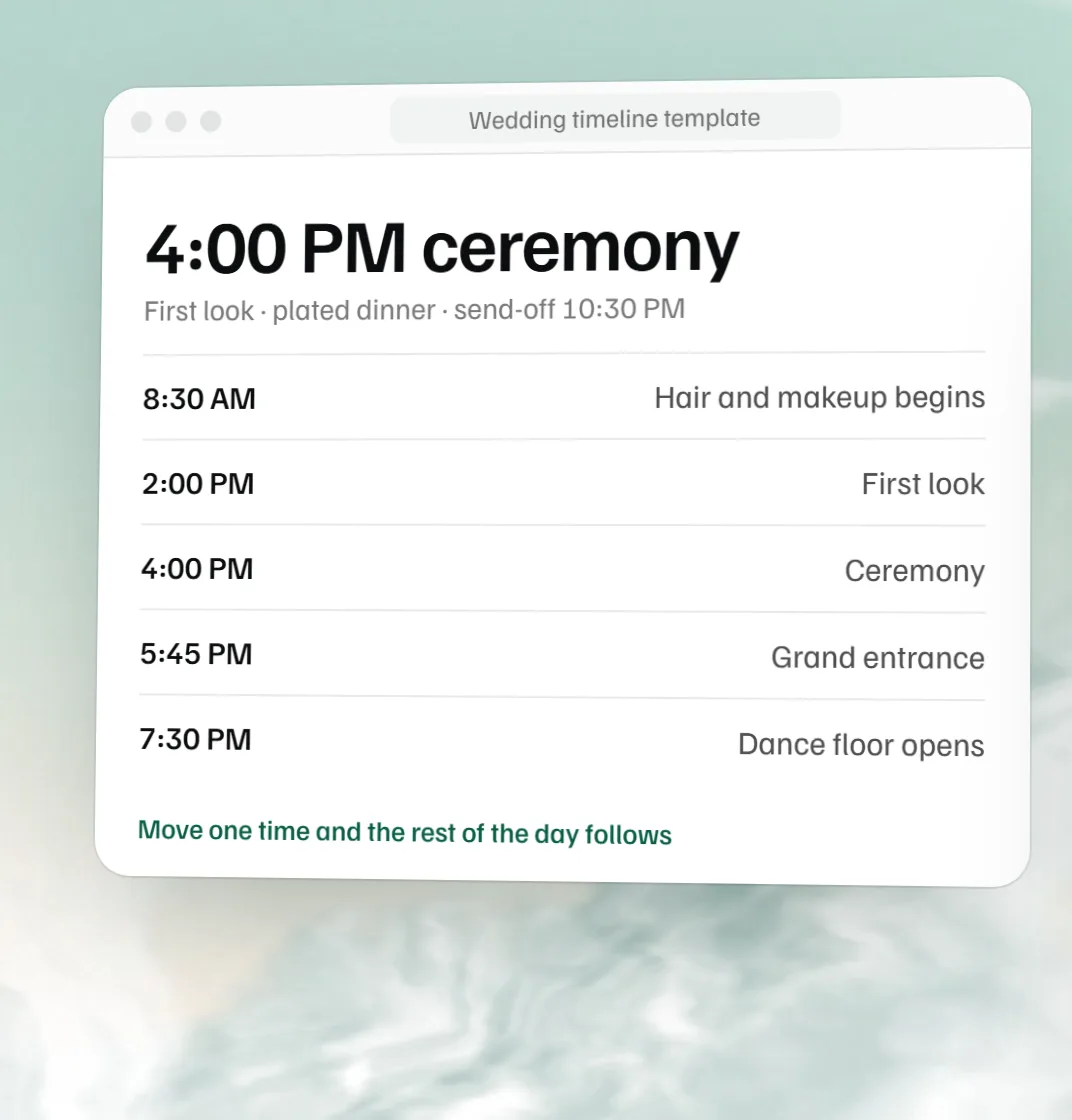 Free wedding timeline template The wedding day hour by hour, built from the ceremony time.
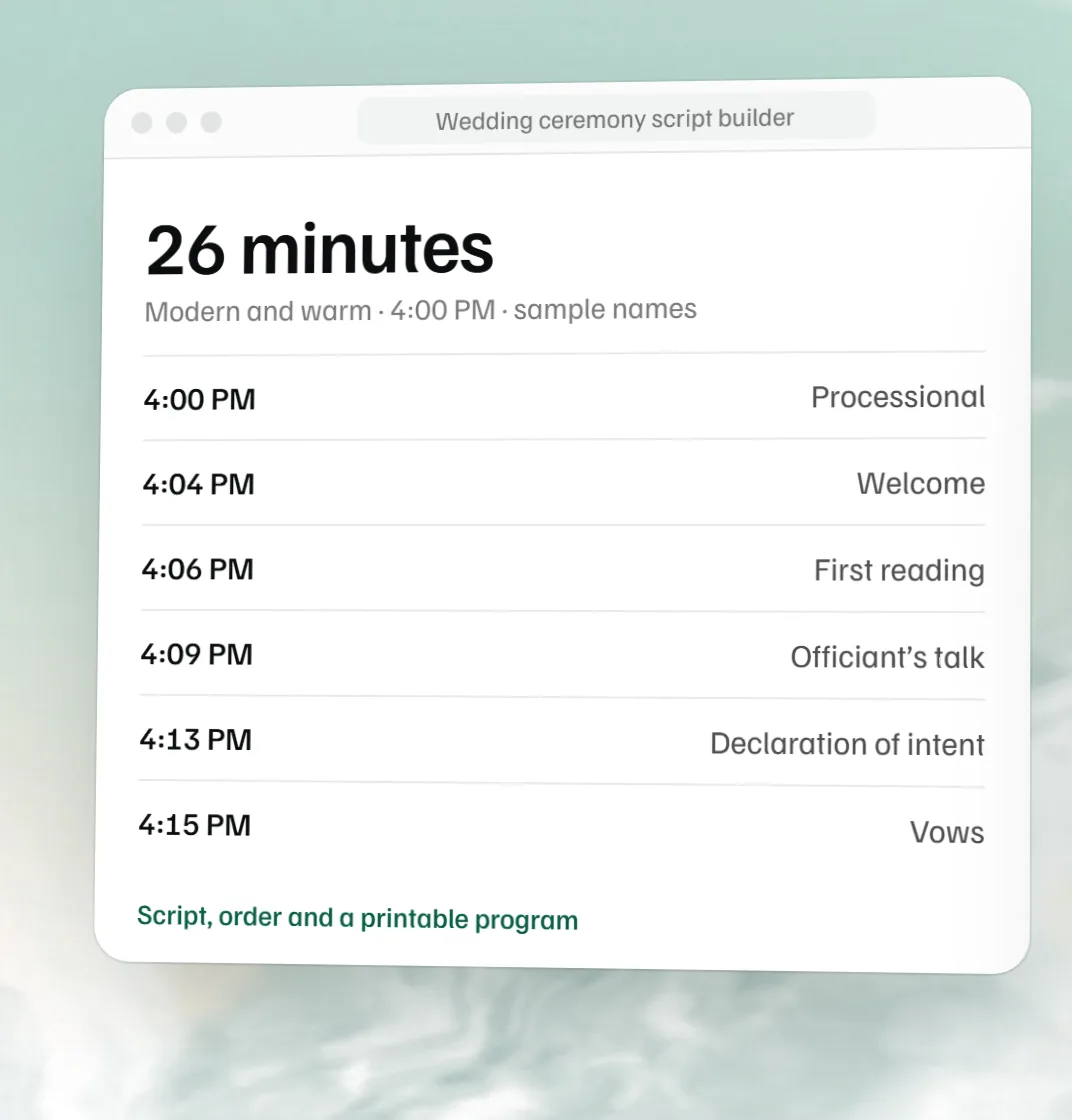 Free wedding ceremony script builder The officiant’s script, the order with minutes and a printable program.
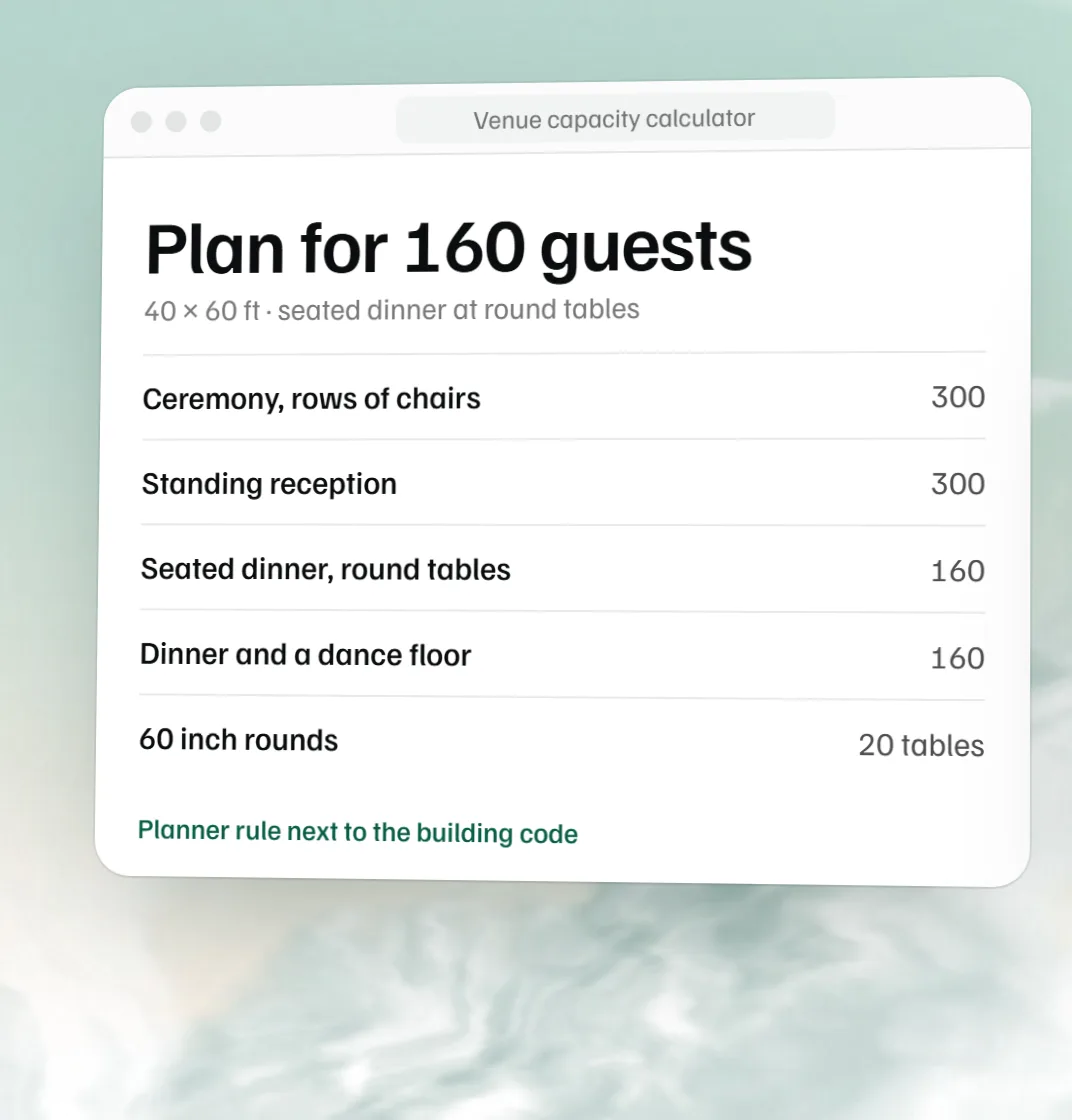 Free venue capacity calculator How many guests a room holds by setup, next to the code count.