Free portable restroom calculator: how many porta potties?
The rule we use is one portable restroom for every 50 guests at an event of up to 4 hours, half as many again when alcohol is served, and 12.5% more for each hour past 4.
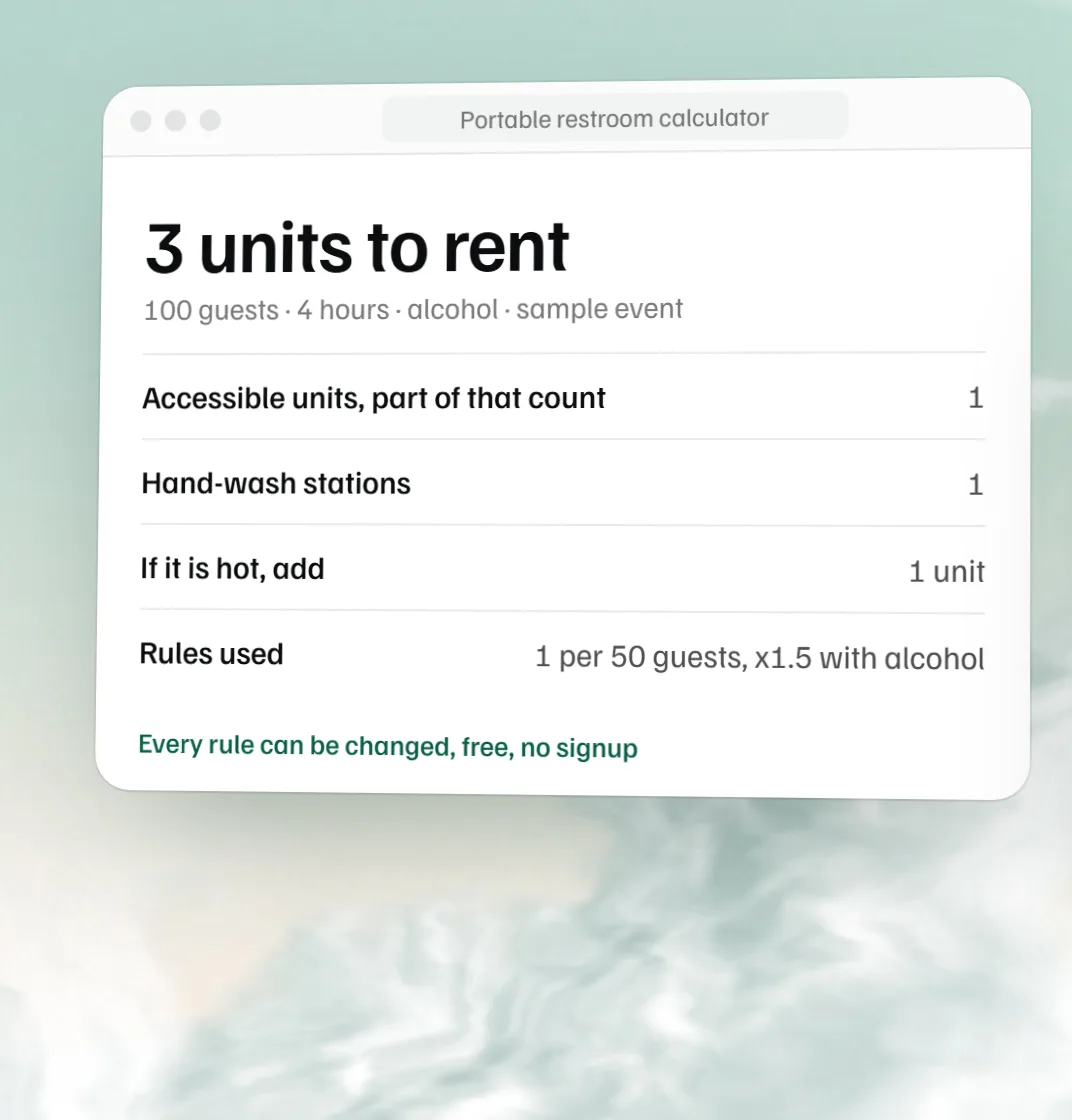
So 100 guests over 4 hours need 2 units without alcohol and 3 with. Change any number below; your rental company and local authority have the final say.
3 units to rent
100 guests, 4 hours, alcohol served.
| Units to rent | 3 |
|---|---|
| Accessible units, part of that count | 1 |
| Hand-wash stations | 1 |
| If it is hot, add | 1 unit |
Rules used: one unit per 50 guests for 4 hours, 12.5% more for each hour past 4, x1.5 with alcohol, x1.1 with food, x1.2 if everyone arrives at once. Rounded up.
Delivery and service
- One day and under 8 hours: delivery before and pickup after is the usual ask. Confirm that no service visit is needed during the event.
- Ask for a delivery window that ends well before guests arrive, and tell the company where the truck can get in.
Where to put them
- Near the entrance or the parking, so guests find them without asking.
- Within an easy walk of the bar, but not so close that the line runs through the bar queue.
- Away from any food service, and downwind of the seating where you can.
- On a lit path. Plan lights for evening events, and ask the rental company about lighting in the units.
- On level, firm ground, with a clear way in for the delivery truck and the service truck.
- A firm, level, step-free route to the accessible unit, with that unit at the front of its group.
- A hand-wash station beside each group of units, not out of sight.
The sample is 100 guests for 4 hours with alcohol and no meal. It is a rule-of-thumb count, not a quote: the rental company and your city or county decide what the event needs.
The rules this calculator uses
These are common rental-industry rules of thumb, written down as the rules this page uses. They are not a standard, and rental companies chart them differently. Each one is a box in the rules section under the form, so change it to match what your rental company tells you.
- Base: one unit for every 50 guests at an event of up to 4 hours.
- Longer events: 12.5% more for each hour past 4, counted up to 12 hours. Past that, ask for service visits rather than more units.
- Alcohol: 1.5 times the units.
- Food: 1.1 times the units.
- Everyone arrives at once: 1.2 times the units, because the lines peak together.
- Women's share: 5% more for every 10 points above half the crowd, and 5% fewer for every 10 below.
- The venue's restrooms: each stall counts as one unit and each urinal as 0.5, only if guests can use them for the whole event.
- Accessible units: at least one, then one for every 20 units, counted inside the total.
- Hand-wash stations: one for every 4 units, at least one.
- A hot day: 10% more units, and never fewer than one extra.
The result is rounded up, since you cannot rent part of a unit. That is why 100 guests over 4 hours with a meal and no alcohol needs 3 units when the arithmetic says 2.2.
How many porta potties for 50 to 500 guests
This is an example, not a quote. It runs the calculator's own rules for five crowd sizes at 4 and 8 hours, with and without alcohol.
| Guests | 4 hours, no alcohol | 4 hours, alcohol | 8 hours, no alcohol | 8 hours, alcohol |
|---|---|---|---|---|
| 50 | 1 | 2 | 2 | 3 |
| 100 | 2 | 3 | 3 | 5 |
| 150 | 3 | 5 | 5 | 7 |
| 250 | 5 | 8 | 8 | 12 |
| 500 | 10 | 15 | 15 | 23 |
Read across for the effect of alcohol and down for the effect of the crowd. At 250 guests, 4 hours with alcohol needs 8 units against 5 without. At 500 guests over 8 hours with alcohol, it is 23. A meal adds 10% to any of these, and a crowd that arrives all at once adds 20%.
Why events with alcohol need more
Drinkers visit more often. Alcohol is a diuretic, and a bar means guests are taking in more liquid than they would at a dry event. The rule we use is 1.5 times the units, and it applies to the whole crowd because you rarely know in advance who will drink.
The lines also bunch up. They form after a toast, between a band's sets and when the bar closes. A crowd that was spread across the evening heads for the same doors at once, which is what the arrival box is for. If most of your guests will not drink, set the alcohol box lower, between 1 and 1.5, and see what the number does.
Where to put portable restrooms
The count only works if guests can find the units and use them without a long walk or a long line. A short checklist for the site walk:
- Near the entrance or the parking, so guests find them without asking.
- Within an easy walk of the bar and the seating, but not beside either. A line should not run through the bar queue.
- Away from food. Keep them well clear of where food is served or prepared, and ask the caterer and your local rules how far that is.
- On a lit path. If the event runs past dusk, plan lights along the route and ask the rental company about lighting inside the units.
- On level, firm ground with a clear way in for the delivery truck, and the same way out for the service truck.
- In more than one spot when you rent six or more units. Groups of a few keep one door from collecting every line.
- With the accessible unit at the front of its group, on a step-free route.
- With a hand-wash station beside each group, in view.
Accessible units and the path to them
An accessible unit is a larger portable restroom made for a wheelchair or another mobility aid. They are often called ADA units. The rule we use is at least one, then one for every 20 units, counted inside your total. Whether your event has to provide one, and how many, is for your city or county and your rental company to say. Ask early.
The unit helps nobody if guests cannot get to it. Plan a firm, level, step-free route from the entrance and the parking: no loose gravel, no soft grass, no curb. Where the ground is soft or slopes, ask the rental company what they can lay down. Put the unit at the front of its group with room to turn around outside it, and keep fences, cables and catering trucks away from the door.
Hand-washing and supplies
The rule we use is one hand-wash station for every 4 units, and at least one. Put it beside the units where guests will see it. Ask the rental company what the station holds, which is usually fresh water, waste water, soap and towels, and who refills it. Washing with soap and water is the better choice; sanitizer is a convenience for the line.
Ask who stocks the units and keep spares on site: toilet paper, paper towels, soap, trash bags and a bin outside the units.
What to ask the rental company
Give them your guests, hours, whether alcohol and food are served and the date. Many have their own chart. Compare it with this page's, and ask why if the two are far apart. Then ask:
- The delivery window. When the truck arrives, when it leaves, and when it comes back to pick the units up. Ask for a window that ends well before guests arrive.
- Service during the event. Whether a visit is included, what each one costs, and whether the truck can reach the units while guests are on site.
- A key or lock. Whether the units lock, who holds the key, and whether you want them shut until the event starts or overnight.
- An attendant. Whether one is available for a large or long event, what they do and what they charge by the hour.
- Power for lights. Whether the units have lights of their own or need power, and what the rental company wants from you for an evening event.
- Accessible units and hand-wash stations. How many they have for your date, and when to book.
Weather and ground
Grass. Units go on level, firm ground. After rain a lawn can soften enough to leave ruts under the truck or tilt a unit, so ask the venue about its ground rules and put the units on the firmest ground that is still near the crowd. Slopes. A unit on a slope is hard to use, and a slope also changes where the truck can go. Choose the flattest spot even if it is a few steps further.
Wind. An empty unit is light. Ask the rental company how it secures units on an open site, and tell them if the site is exposed. Hot days. Units heat up in full sun. Shade them if you can, and add units: the rule we use is 10% more, and never fewer than one extra. Cold. Ask whether the units and the hand-wash station are set up for freezing temperatures.
Permits and local rules
Rules differ by city and county. Some places require a permit for an event or for temporary sanitation, some set their own ratios, and some say how far units must sit from food, water or a property line. Ask the venue first, since the venue knows its own capacity and limits. Then ask the city or county. Your rental company often knows the local requirements and may be able to tell you what they have delivered for similar events.
This page gives a planning count. It is not a permit application and not legal advice, so do not rely on it where a local authority sets the number.
For venues and planners
An outdoor or tent event adds a restroom line to the budget and to the site plan. The budget line is the rental, delivery, service visits, an attendant and the hand-wash station. The site plan line is where the units go and how the truck gets there.
Mark the units on the floor plan, so the rental company, the caterer and the bar all see the same spot. Size the rest of the site with the free tent size calculator, check the guest count against the room with the free venue capacity calculator, and draw the layout in the free event floor plan maker. If guests will use your own restrooms, count the stalls and urinals and put them in the calculator, so the rental covers only what is left.
MyVenueHQ keeps the layout, the vendor list and the BEO on one event, so the restroom rental sits next to the tent and the caterer.
Add this portable restroom calculator to your website
Venues, planners and wedding blogs can put it on their own site for free. Paste this where you want it; it works in WordPress, Squarespace, Wix and plain HTML. Nothing is tracked about your visitors beyond page views.
Porta potty questions.
How many porta potties do I need for an event?
The rule we use is one for every 50 guests at an event of up to 4 hours, half as many again if alcohol is served, and 12.5% more for each hour past 4. So 100 guests over 4 hours need 2 without alcohol and 3 with. Put in your own guests, hours, food and crowd above; your rental company and local authority decide what the event needs.
How many porta potties for 50, 100 and 200 people?
For a 4 hour event with no alcohol: 1 for 50 people, 2 for 100 and 4 for 200. With alcohol: 2, 3 and 6. For 8 hours with alcohol: 3, 5 and 9. These are our rules with no food, guests arriving over the event and half of them women.
How many porta potties for a wedding?
A wedding usually serves alcohol and a meal over five hours or more, so it sits at the high end. At our rules, a 5 hour wedding with alcohol and food needs 2 units for 50 guests, 4 for 100, 6 for 150 and 8 for 200. If the venue's own restrooms are open to guests all day, tick that box and the calculator takes their stalls off the number to rent.
How many porta potties do I need with alcohol?
The rule we use is 1.5 times the count: 3 units for 100 guests over 4 hours instead of 2, and 8 for 250 instead of 5. People who drink visit more often, and you rarely know in advance who will. If most of your crowd will not drink, lower the alcohol box in the rules section.
How many ADA porta potties do I need?
The rule we use is at least one accessible unit, then one for every 20 units, counted inside your total rather than added to it. Whether your event must provide one, and how many, is for your city or county and your rental company to say. Ask early, because accessible units are fewer than standard ones, and plan a firm, level, step-free route to the unit.
How often should porta potties be serviced?
Rental companies set their own schedules, so ask. For a one day event under 8 hours, delivery before and pickup after is the usual ask. For a long day or a large crowd, ask about a service visit or an attendant during the event. For an event of several days, ask for service at least once a day and what each visit costs.
Can guests use the venue's restrooms instead of porta potties?
Sometimes. Ask the venue whether guests may use its restrooms for the whole event, how many stalls and urinals there are, and whether it limits use, for example by plumbing or septic capacity. Then check the walk: restrooms at the far end of a building, or up a flight of stairs, do not serve a crowd outside on a lawn. Tick the venue's restrooms in the calculator to take their stalls and urinals off the number to rent.
Related free tools
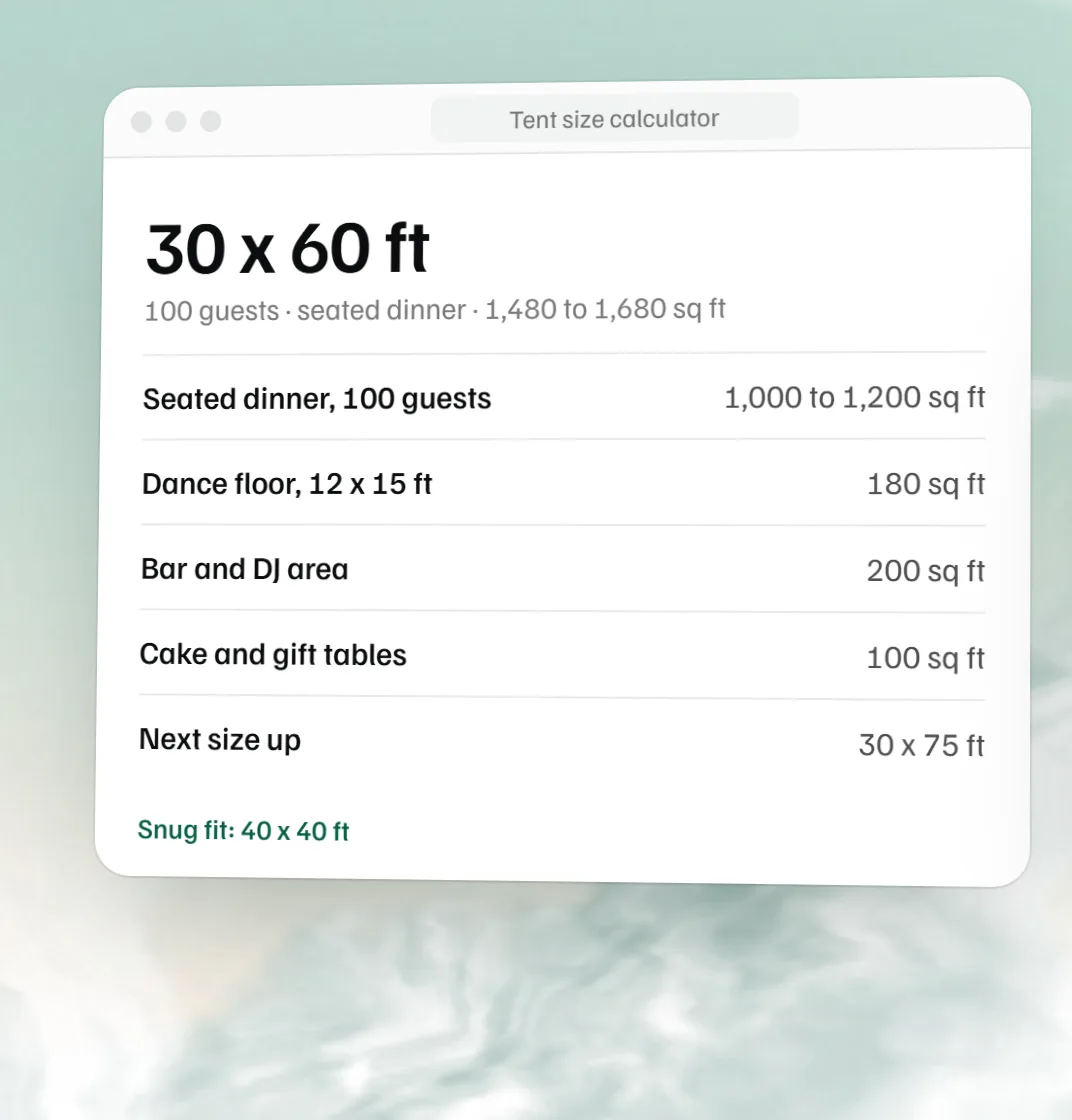 Free tent size calculator The tent to rent for the guests, tables and extras.
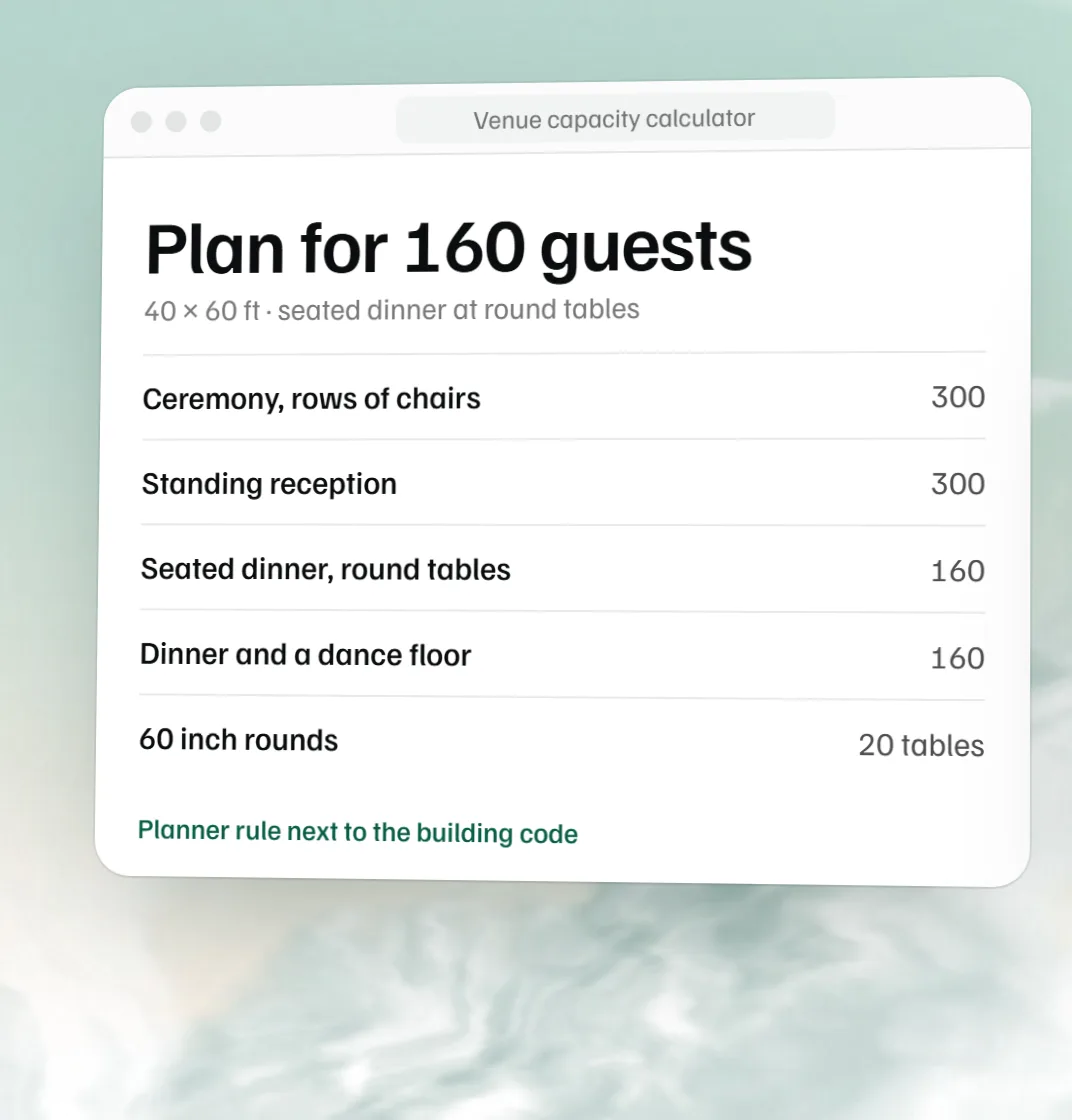 Free venue capacity calculator How many guests a room holds by setup, next to the code count.
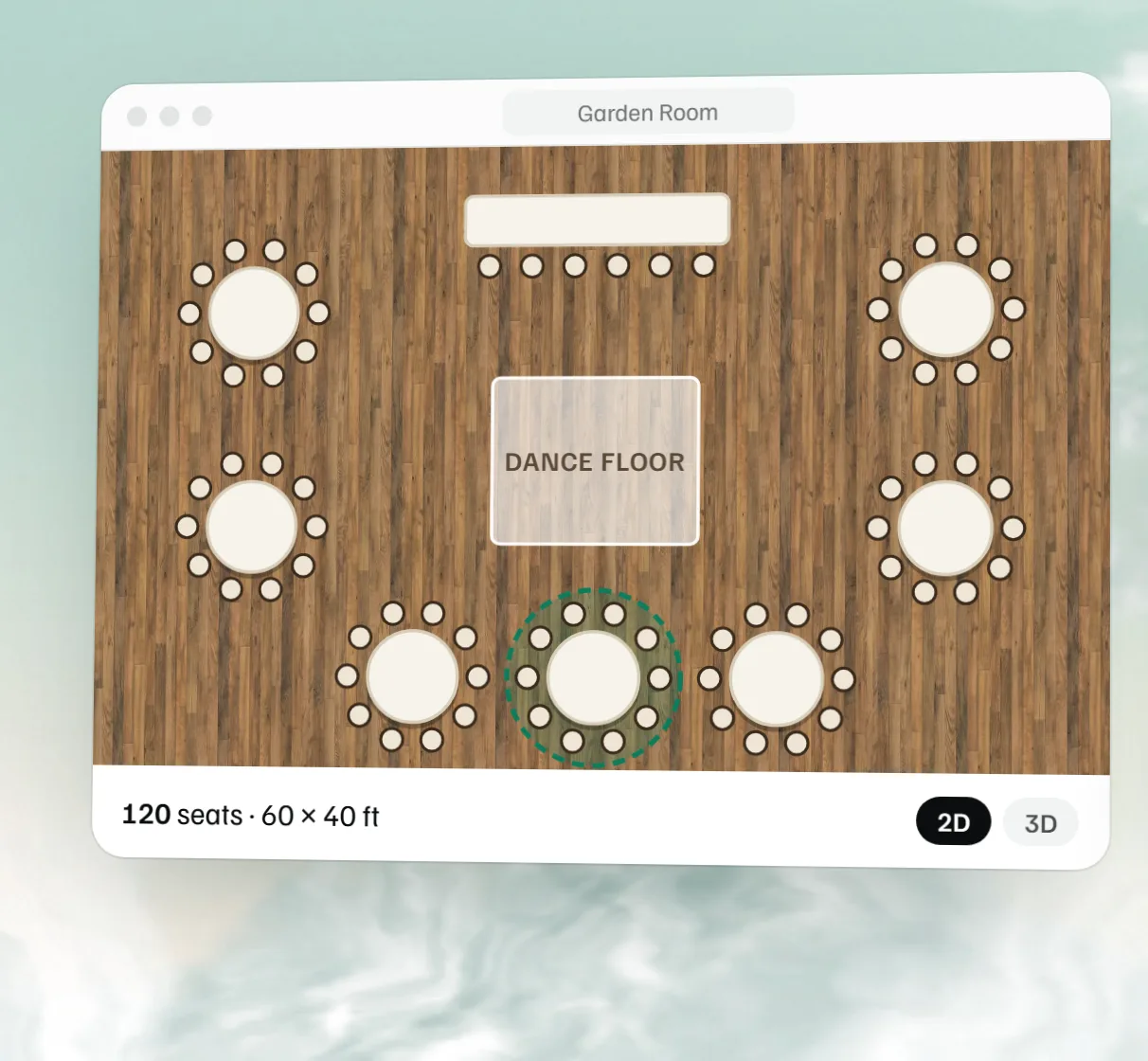 Free event floor plan maker Draw the room to scale with tables, stage, bar and dance floor, then see it in 3D.
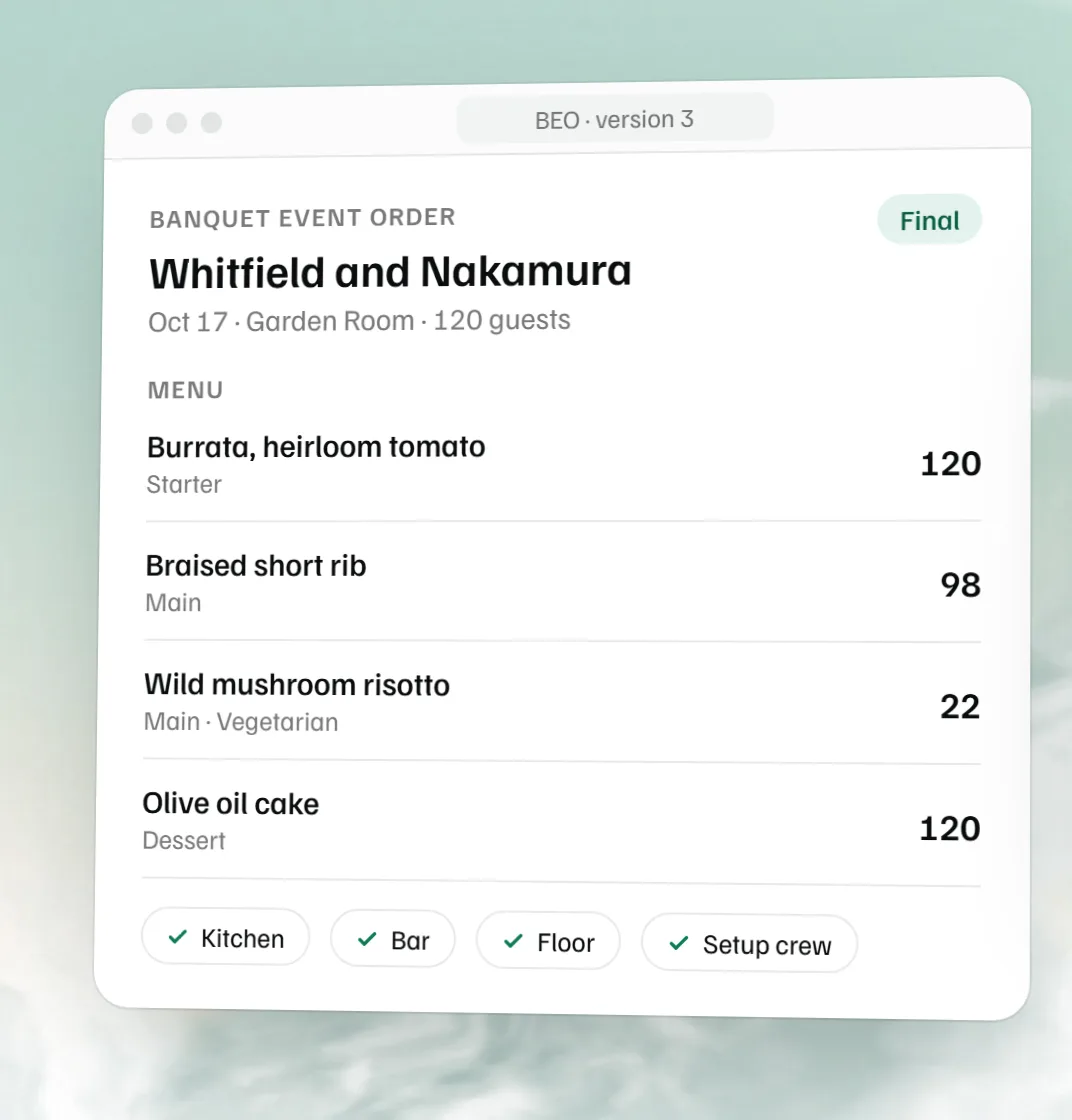 Free BEO template The banquet event order for the kitchen, bar and floor, as a Word file.