That one test decides who gets the money and how it’s taxed. This post covers both for a wedding or event venue, then how to write each one on a BEO, a proposal and an invoice, and what to tell the client. It reads IRS and federal wage-rule wording in plain language. It isn’t legal or tax advice, so ask your accountant how it applies to your venue and your state.
Service charge vs gratuity at a glance
| Question | Service charge | Tip (a gratuity the guest chooses) |
|---|---|---|
| Who sets the amount? | The venue. | The guest. |
| Can the client say no? | No. It’s on the contract. | Yes. |
| Who gets the money? | Wherever the venue’s policy sends it. The venue can keep some or all of it. | The staff the guest means it for. |
| How the IRS treats what staff receive | Wages, handled like regular pay. | Tips, which the employee reports to the employer. |
What the IRS says
IRS Fact Sheet FS-2015-8 (February 2015) reminds employers that automatic gratuities are service charges, not tips. It gives four factors for a tip: the payment is free from compulsion, the customer can set any amount, the amount isn’t negotiated or dictated by the employer’s policy, and the customer generally chooses who receives it. If any one of them is missing, the sheet says there is doubt the payment is a tip and it may be a service charge.
The sheet’s list of service charges “commonly added to a customer’s check” includes a banquet event fee, next to a large dining party automatic gratuity. It also says that calling a payment a tip, whether the employer or an employee does it, doesn’t decide the question.
For the staff, the sheet says an employer who distributes service charges treats them like regular wages for withholding and filing, following IRS Publication 15. Only the amount actually distributed counts as wages; some employers keep a portion. Tips follow another path. Employees report cash tips to the employer, and the employer withholds on them. A later sheet, FS-2017-08 (April 25, 2017), repeats the split and adds the W-2 boxes: distributed service charges go in boxes 1, 3 and 5, reported tips in boxes 1, 5 and 7. The IRS marks both pages as archival, so check its current guidance before you rely on the details.
What the federal wage rules add
The Department of Labor’s rule on amounts that aren’t tips, 29 CFR 531.55, says a compulsory charge for service, such as a flat percentage added to a bill, isn’t a tip even if the employer passes it to the staff. Service charges that become part of the employer’s gross receipts aren’t tips either. When an employer distributes them, they can count toward the minimum wage. We couldn’t read the Department’s own fact sheet on tipped employees (the page blocked us), so the regulation text is the source here.
Where the money goes at a venue
A venue can send its service charge to the service staff, pay it through payroll as wages, put it toward the cost of running events, or split it between those. The choice is the venue’s, and it’s the question every couple asks. Two venues that both quote 20% can mean opposite things for the bartender.
A tip goes the other way. It belongs to the people the guest hands it to, or to a pool the staff share.
A worked example
Suppose a wedding has a $12,000 food and beverage subtotal and the venue adds a 20% service charge. The venue’s policy pays 70% of that charge to the service staff through payroll and keeps the rest. The couple also hands the bartenders a $300 envelope. These figures are made up for the example. Sales tax is left out, because whether it applies to a service charge depends on the state.
| Line | Amount | What it is |
|---|---|---|
| Food and beverage | $12,000 | The venue’s price for the food and drinks. |
| Service charge, 20% of $12,000 | $2,400 | A required fee, set by the venue. |
| Paid to staff, 70% of the charge | $1,680 | Distributed, so handled like regular pay. |
| Kept by the venue, the other 30% | $720 | Not wages. |
| Envelope for the bartenders | $300 | A tip: the couple chose it, and the bartenders report it. |
| The couple pays | $14,700 | $12,000 + $2,400 + $300 |
Of the couple’s $14,700, only $300 was a tip. If the contract had called the $2,400 a “gratuity”, the IRS would still count it as a service charge, because the couple couldn’t decline it.
How to show each on a BEO, proposal and invoice
Give every charge its own line, with its rate, what it’s calculated on and who receives it. The client can’t mistake one line for another, and your staff have an answer when a guest asks whether to tip.
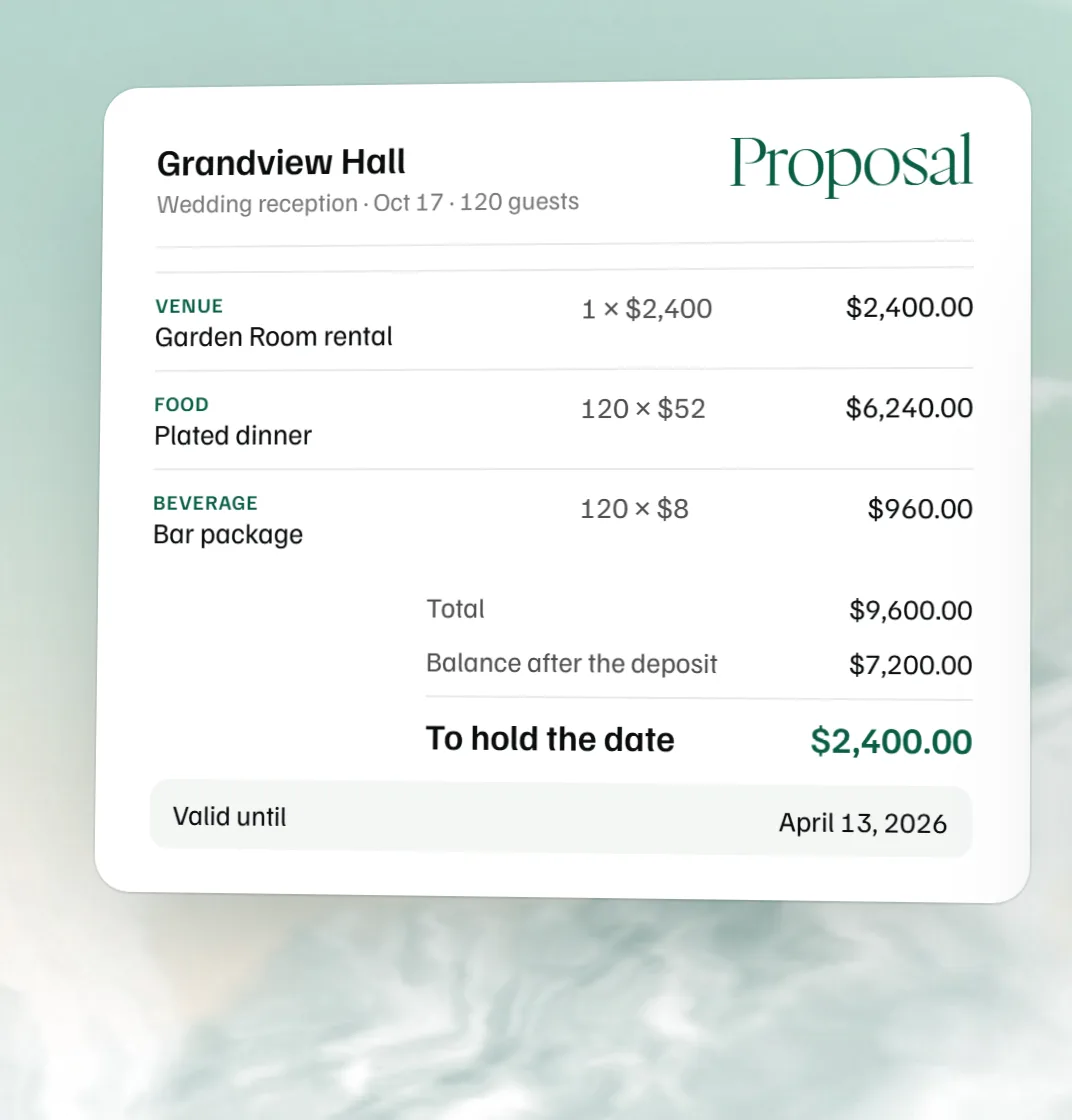
- Proposal. One line per charge, such as “Service charge, 20% of food and beverage”, with one sentence under it on what it covers and who receives it.
- Contract. Say the service charge is required, say whether tips are welcome, and say whether they go to individuals or a pool. Sample wording to adapt: “A service charge of 20% of food and beverage is added to the final bill. It is the Venue’s charge and is not a gratuity. Gratuities for staff are optional.” Have an attorney in your state review the final text.
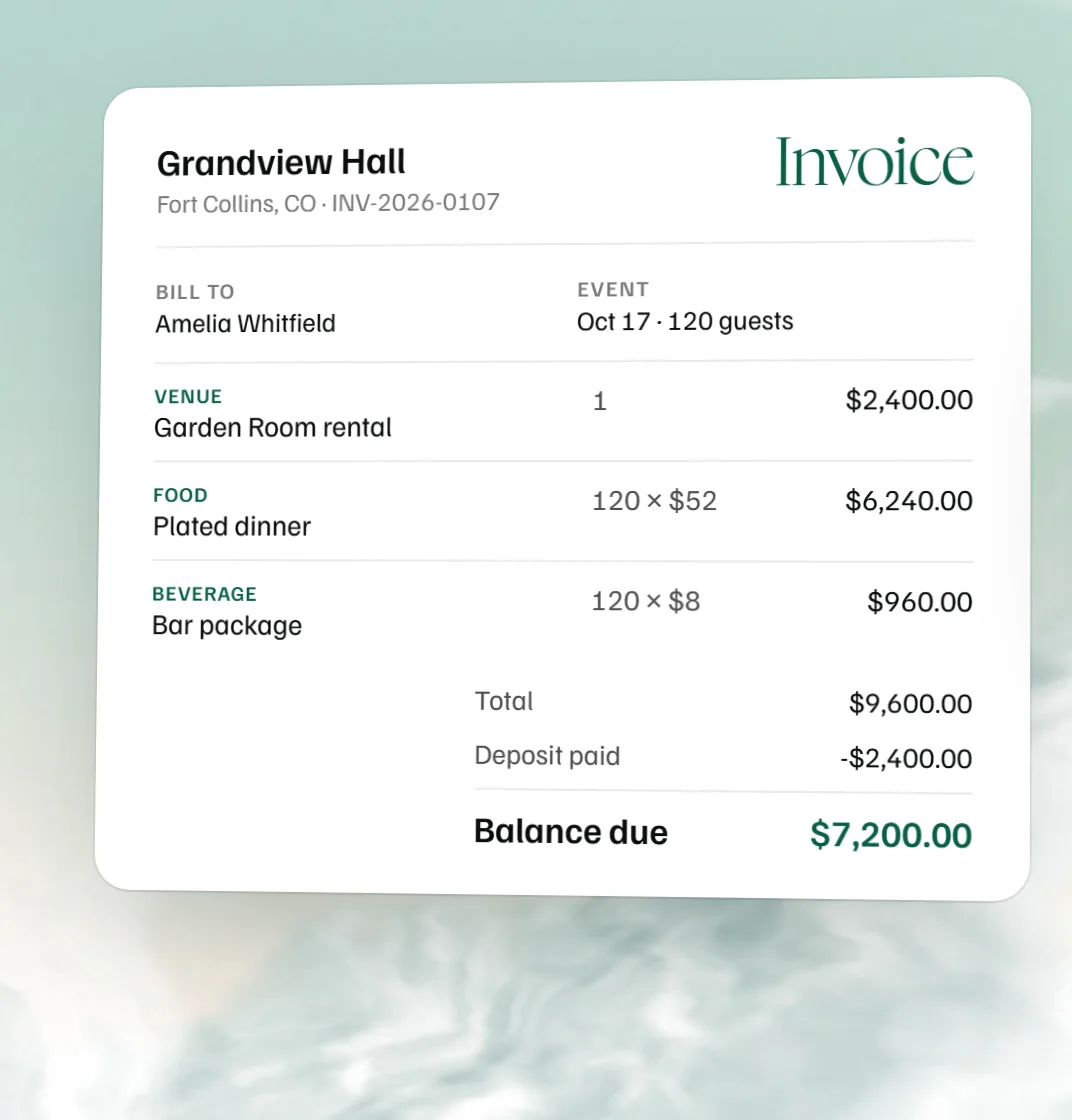
- Invoice. Keep “Service charge” and “Gratuity” on separate lines. Use “Gratuity” only for an amount the client chose to add.
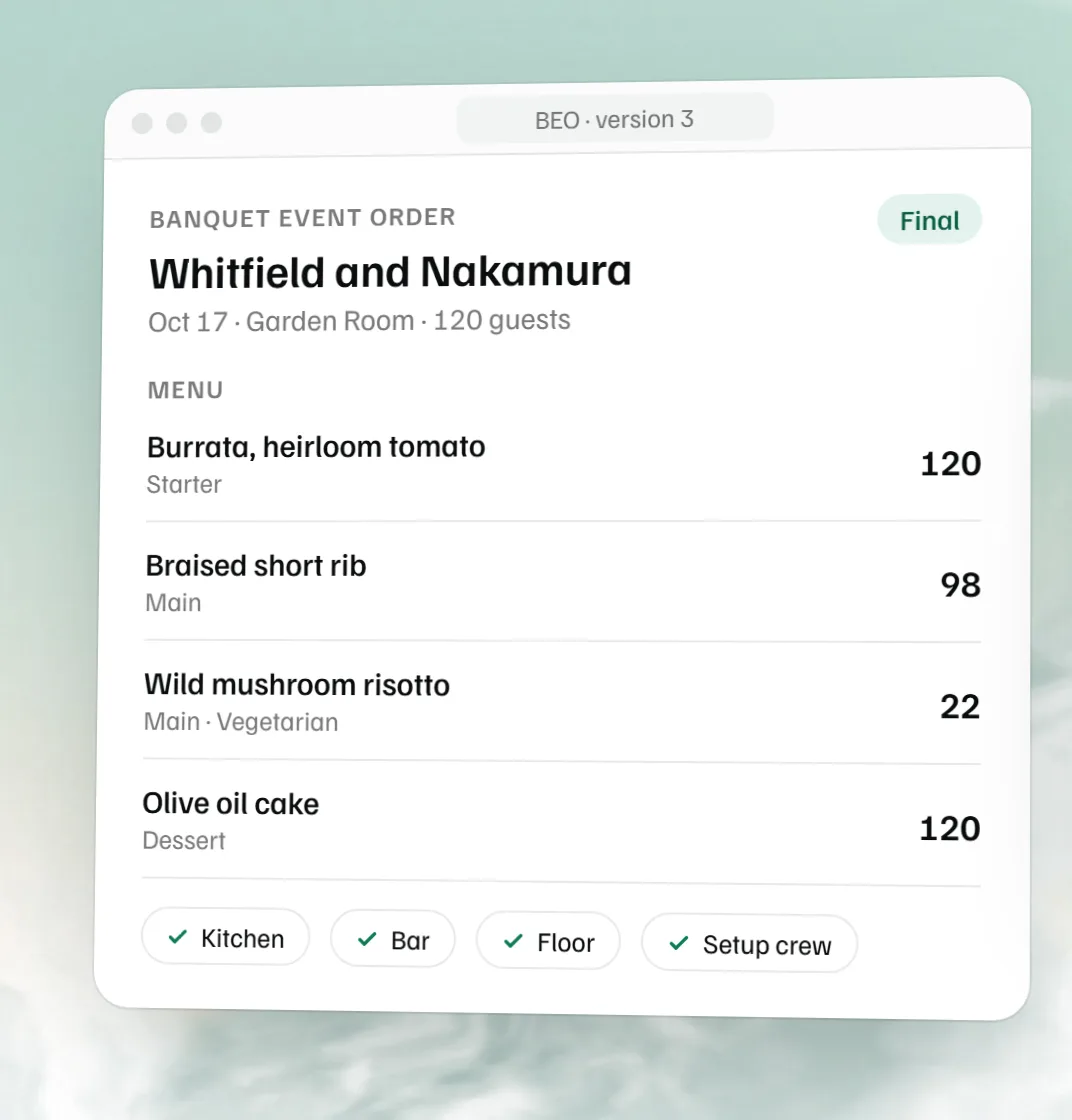
- BEO. The BEO is the sheet the kitchen and floor work from, so put the answer staff give a guest: “Service charge included on the final bill. Tips are optional.” The banquet event order guide shows where the line fits.
What to tell the client
Say what the percentage applies to, who receives it, and whether a tip is welcome. Example wording, which you should change to match your policy: “The 20% service charge applies to food and beverage. Most of it goes to the service staff through payroll and the rest covers the cost of the event. Tips are optional. If you’d like to give one, hand it to me and I’ll make sure it reaches the bar team.” Say it at the tour, write it in the proposal, and say it again at the final walk-through.
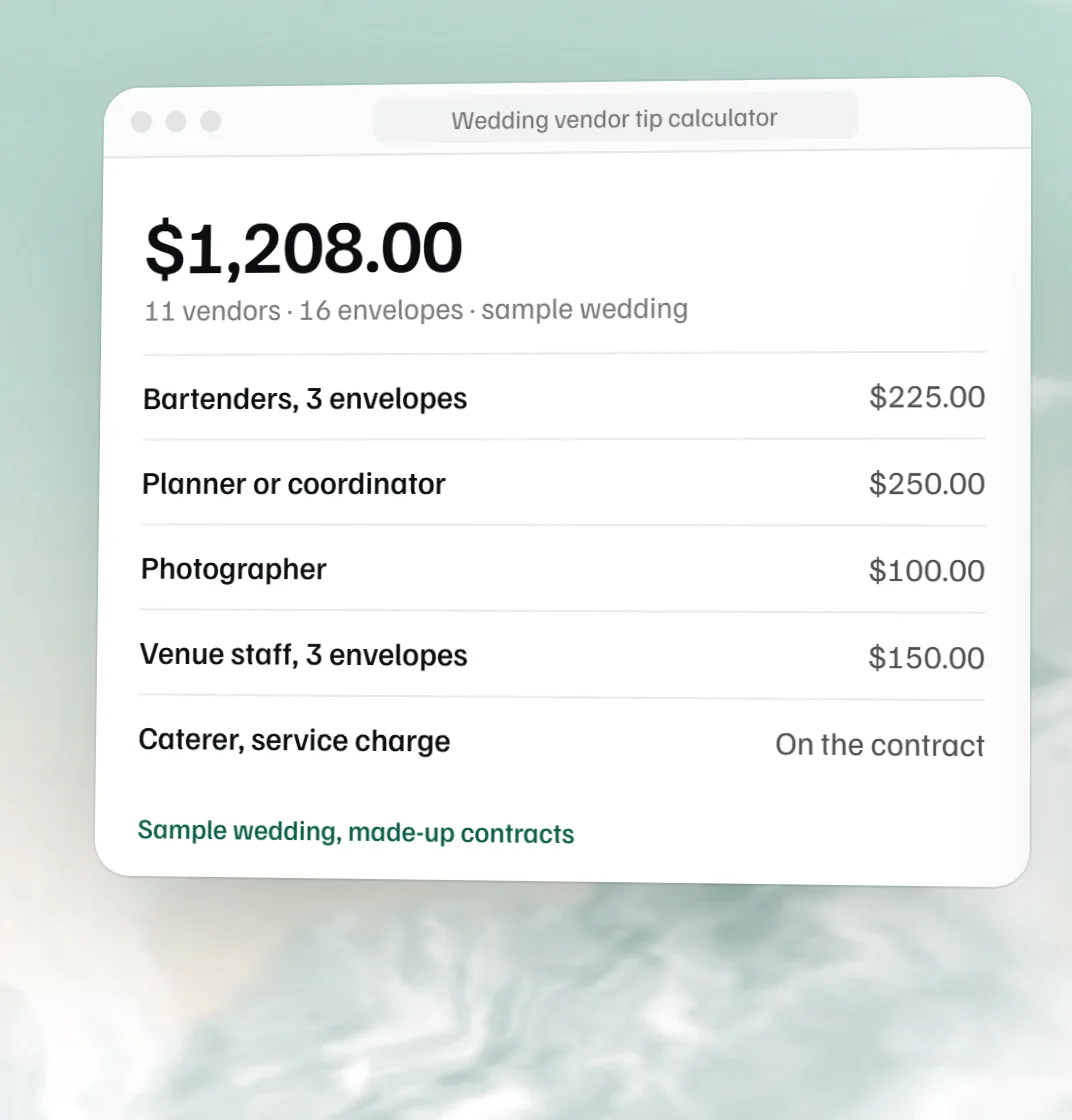
Couples read your lines the way the free wedding vendor tip calculator does, asking whether a service charge reaches the staff. Answer it before they ask.
Next step
Open your current proposal and find every line that says gratuity. If the client can’t decline it, rename it service charge and add one sentence on who receives it. The free event proposal template has the lines ready, and our guide to how wedding venues price lists the other fees a quote should show.
This post is a plain-words reading of public IRS and Department of Labor wording. It isn’t legal or tax advice.
Sources
- IRS, Fact Sheet FS-2015-8, Tips Versus Service Charges: How to Report (February 2015, marked archival by the IRS; PDF at irs.gov/pub/irs-news/FS-15-08.pdf). The four factors, the service charge examples including a banquet event fee, and the reporting rules. Read October 16, 2026.
- IRS, Fact Sheet FS-2017-08 (April 25, 2017, marked archival by the IRS). The wage treatment of distributed service charges and the W-2 boxes. Read October 16, 2026.
- Legal Information Institute, 29 CFR 531.55, Examples of amounts not received as tips. Read October 16, 2026.
 Free event proposal template
 Free catering invoice template
 Free BEO template
 Free wedding vendor tip calculator