Free catering contract template: fill it in, then download Word or PDF

A catering contract names the caterer and the client, the event, the menu, the price, the deposit and the cancellation terms, and says what happens when the guest count changes. This template, also called a catering agreement or catering service agreement, writes it from what you fill in: put in the menu, the guest count and your prices, and it works out the deposit and balance and writes the clauses for the final count, cancellation, leftovers, alcohol and liability. Download it as Word or print it to PDF, no signup.

Your business
Client
Event
Menu and service
Price

Other charges, flat amounts: bar, rentals, cake cutting, delivery.

Payment
Cancellation

When the client cancels, and what they owe. Use your own policy.

Terms

Juniper Table Catering

Golden, CO · (720) 555-0148 · events@junipertable.example

Catering contract

This contract is between Juniper Table Catering (“Caterer”) and Priya Raman and Owen Castillo (“Client”) for catering at the event below, dated October 16, 2026.

Event
Raman and Castillo wedding reception, Wedding
Date
June 12, 2027
Service
5:00 PM to 10:00 PM
Venue
Hollis Creek Barn
Evergreen, CO
Guests
140
Client contact
priya@example.com, (720) 555-0186
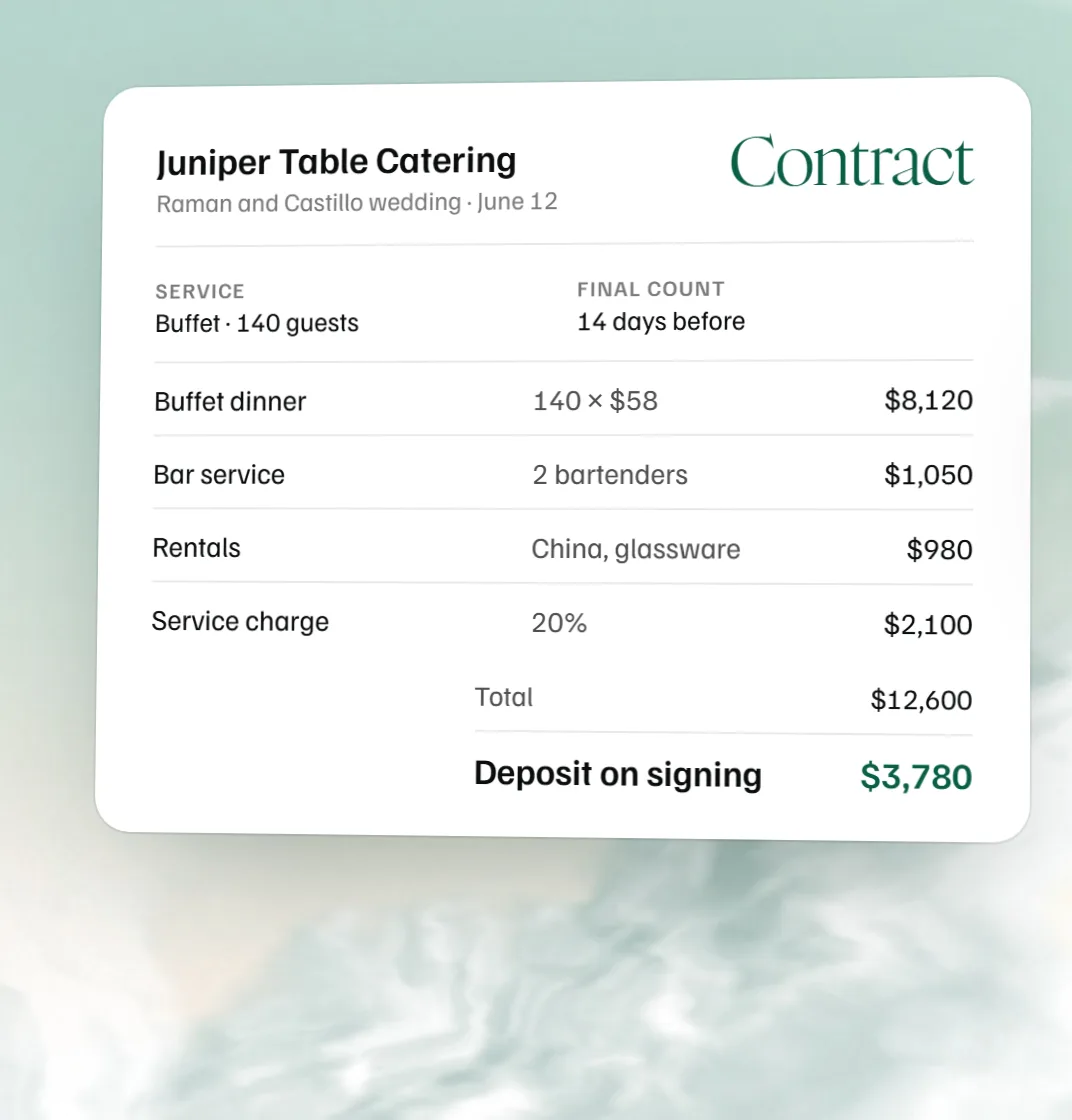
Buffet menu, 140 guests at $58.00 a guest$8,120.00
Bar service: 2 bartenders, mixers, ice and garnish$1,050.00
China, flatware and glassware rental$980.00
Cake cutting and service$350.00
Subtotal$10,500.00
Service charge (20%)$2,100.00
Total$12,600.00
Deposit$3,780.00
Balance$8,820.00

1. Menu

Caterer will prepare and serve this menu, buffet service:

Passed appetizers: goat cheese crostini, chicken satay
Salad: mixed greens, citrus vinaigrette
Buffet: herb roast chicken, braised short rib, roasted vegetable pasta
Sides: garlic mashed potatoes, green beans, dinner rolls
Kids: chicken tenders and fruit

2. Staffing, rentals and equipment

Staff: 1 event captain, 8 buffet and service staff and 2 bartenders, on site 3:00 PM to 11:00 PM

Rentals and equipment Caterer provides: Buffet tables and linens, chafing dishes, china, flatware and glassware for 140. The venue provides guest tables and chairs.

Client confirms the venue allows outside catering and arranges access for Caterer to set up and clean up.

3. Guest count

The estimated guest count is 140. Client gives Caterer the final guest count in writing at least 14 days before the event.

The final count is the minimum Client pays for. If fewer guests attend, the charge stays at the final count. If more guests attend and Caterer can serve them, Client pays for the extra guests at the same per-guest price.

4. Price and payment

The total is $12,600.00, as set out in the table above. If the final guest count changes, the total changes with it.

Client pays a deposit of $3,780.00 (30% of the total), due on signing. Caterer holds the date once this contract is signed and the deposit is paid. The deposit counts toward the total.

The balance of $8,820.00 is due 14 days before the event. Payment methods: Card, check or bank transfer.

5. Cancellation

Client may cancel by written notice to Caterer. What Client owes depends on when the notice arrives:

More than 90 days before the event
Caterer keeps the deposit
30 to 90 days before the event
50% of the total
Less than 30 days before the event
100% of the total

6. Food safety, allergies and leftovers

Client tells Caterer about guest allergies and dietary needs in writing by the final count date. Caterer labels dishes on request but cannot promise any dish is free of an allergen.

For food safety, food that has been set out for service is not packed for guests or Client to take home. Food that was never served stays Caterer’s property.

7. Alcohol

Caterer’s bartenders hold the licenses or permits required where the event takes place. They check ID, serve only guests of legal drinking age, and may refuse or stop service to anyone who appears intoxicated. No outside alcohol goes to Caterer’s bar without Caterer’s written agreement.

8. Liability and insurance

Caterer carries general liability insurance and gives Client a certificate on request. Caterer is not responsible for loss or damage caused by guests, the venue or other vendors. Client pays for damage guests cause to Caterer’s equipment.

9. Events outside anyone’s control

If fire, flood, severe weather, a power failure, a government order or another event outside either party’s control stops the event from going ahead, neither party is liable for the failure. The parties will first try to move the event to a new date; if they can’t agree on one, Caterer refunds what Client has paid, less costs Caterer has already spent on the event.

10. Changes

Changes to the menu, guest count, times or price count only once both parties agree to them in writing. Email is fine. This contract, with anything attached to it, is the whole agreement.

11. Other terms

Meals for 3 vendors (photographer, DJ and planner) are included at no charge.

Caterer

Signature

Name: Juniper Table Catering

Date

Client

Signature

Name: Priya Raman and Owen Castillo

Date

Blank Word template

This template is a starting point, not legal advice. Have a local attorney review it before you use it. Free with no account. Your contract stays in this browser and is never sent anywhere.
The short answer

A catering contract names the caterer and the client, the event’s date, times, venue and guest count, the menu and service style, and the price with the deposit and balance due dates. It also sets when the final count is due and what the client owes if they cancel, and says who answers for allergies, leftovers, alcohol and damage, with both parties signing.

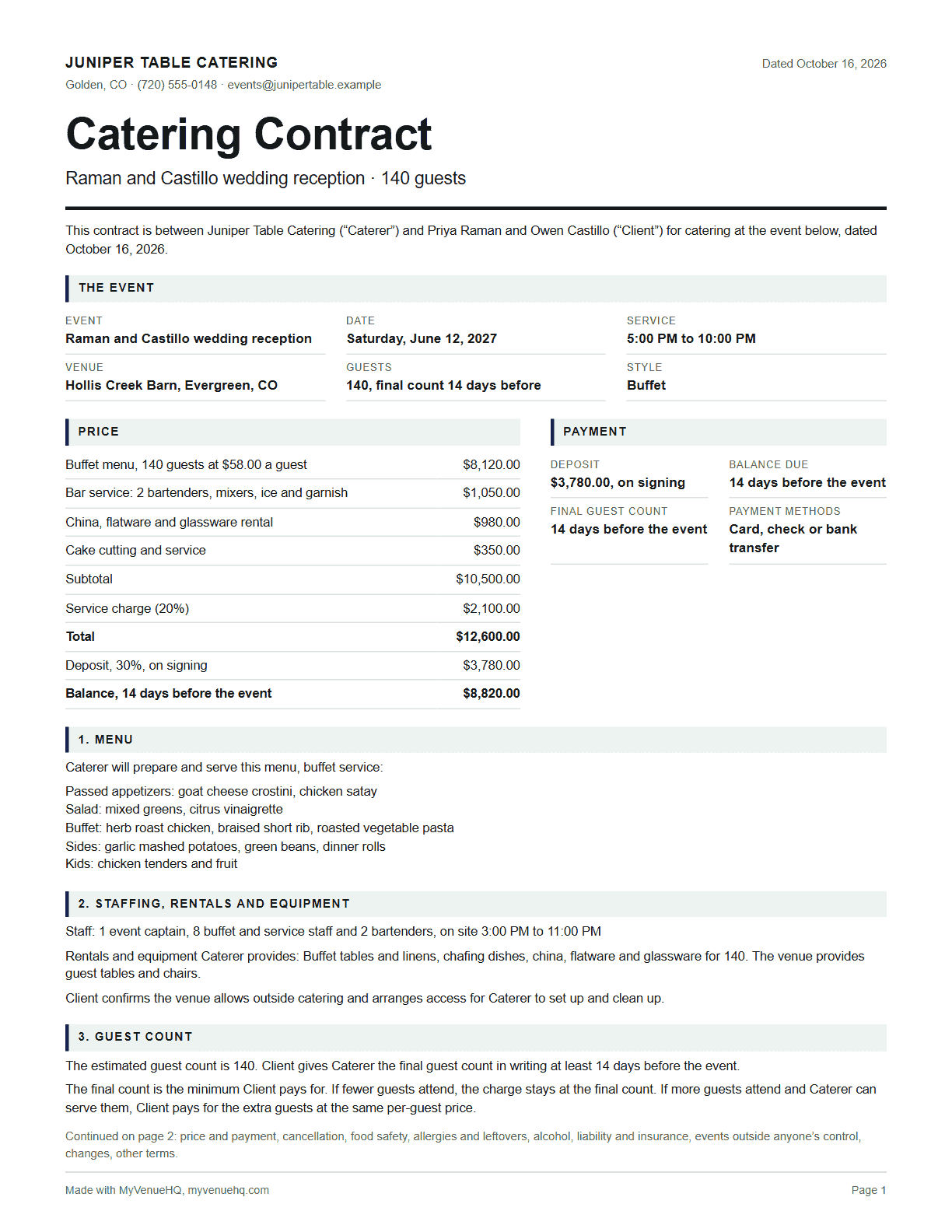
Catering contract template filled in for a 140 guest buffet wedding: parties, event details, price with service charge, deposit and balance, menu, staffing and guest count clauses
Page one of the example contract: a fictional caterer and a 140 guest buffet wedding.
A catering contract for a 140 guest buffet wedding with a $3,780 deposit on signing, beside a contract signed in MyVenueHQ.
Fill it in free here. In MyVenueHQ the client signs on their phone and the deposit invoice follows.

What to put in a catering contract

The template writes each of these from what you fill in. The example is a fictional caterer, Juniper Table Catering, booked for a 140-guest buffet wedding.

ClauseWhy it matters
Parties and contact detailsSays who owes what to whom, and where notices go.
Event date, times and venueGets the crew to the right place at the right hour, and fixes when service ends.
Menu and service stylePlated and buffet cost and staff differently. Written down, nobody argues later about whether dessert was included.
Staffing and rentalsWhat you bring, and what the venue or client supplies.
Guest count and final count dateThe number you order and staff to, and the minimum the client pays for.
Price, deposit and balanceAmounts and due dates, and that the date is held only once the deposit is in.
Cancellation scheduleWhat the client owes at each stage, agreed before anyone needs it.
Allergies and leftoversWho reports allergies and when, and whether served food can go home.
AlcoholLicensed bartenders, ID checks and your right to stop serving someone.
Liability and insuranceWhat you answer for, and what guests, the venue and other vendors do.
Events outside anyone’s controlWhat happens to the money if a storm or a government order stops the event.
Changes in writing and signaturesA phone call doesn’t change the menu; an email both sides agree to does.

Worked example: a 140-guest buffet, from price to balance

The example in the template above is a fictional wedding reception. Each row below is what the template works out from the figures typed into it; change a price, a charge or the deposit in the tool and the contract recalculates the same way.

LineAmount
Buffet menu, 140 guests at $58.00 a guest$8,120.00
Bar service: 2 bartenders, mixers, ice and garnish$1,050.00
China, flatware and glassware rental$980.00
Cake cutting and service$350.00
Subtotal$10,500.00
Service charge (20%)$2,100.00
Total$12,600.00
Deposit, 30% of the total, due on signing$3,780.00
Balance, due 14 days before the event$8,820.00

There is no tax row because the example's rate is 0. Rates depend on the state and sometimes the city, so the template starts at 0 instead of guessing one.

The rule behind each number

The template works in whole cents and follows these rules every time.

  • Food is the guest count times the price per guest: 140 times $58.00.
  • Flat charges, such as bar service, rentals and cake cutting, are added to the food to make the subtotal.
  • The service charge is a percentage of the subtotal. The example uses 20%, which is the caterer's choice and not a standard.
  • Sales tax is a percentage of the subtotal, and also of the service charge if you tick the box that says it's taxable. States differ on whether a service charge is taxed, so the box is yours to set; ask your accountant or the state's revenue department.
  • The deposit is either a percentage of the total or a flat amount, and never more than the total.
  • The balance is the total less the deposit, due on the date you set before the event.

Deposits, final counts and cancellations

The deposit holds the date and pays for early work like ordering and scheduling staff, so it comes with the signed contract. Caterers set it as a flat amount or as a share of the estimated total; Birch & Alder, which publishes its agreement, asks for 50% to book. This template counts the deposit toward the total, and the cancellation schedule says whether any of it comes back.

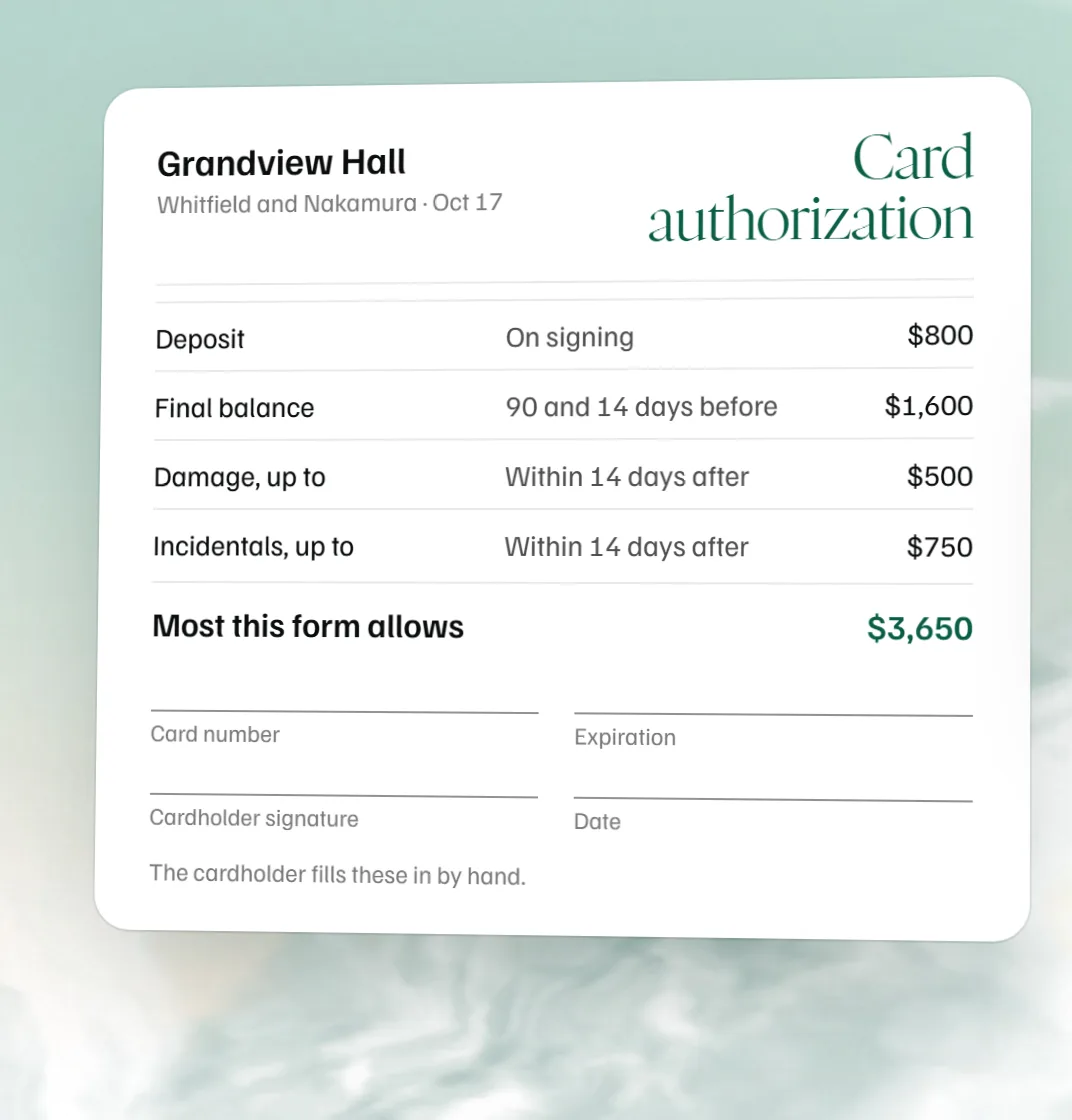
If you charge the final balance to the client’s card on its due date, or add an extra hour of service on the night, get that in writing first with a credit card authorization form. It lists each charge with a cap and a date, and the client writes the card details on it by hand.

The final count date is when the number stops being an estimate. It needs to be late enough that the client knows who is coming and early enough for you to order and staff; Birch & Alder asks for it within 5 days of the event. After that date the final count is the minimum the client pays for. If the count moves before then, the guest count change checklist lists who else needs the new number and the catering food calculator reworks the order.

Cancellation terms step up as the date gets closer, because a late cancellation leaves you little chance of booking the date again. Birch & Alder’s published schedule refunds the whole deposit more than 90 days out, half of it more than 60 days out, a quarter more than 30 days out and none inside 30 days. The template starts with three steps. Change the days and amounts to your own policy, and ask your attorney whether your state limits what you can keep.

What happens to the price when the final count moves

The contract says two things about the count. Before the final count date, the price follows the number the client gives you. After it, that number is the minimum the client pays for, so guests who drop out later don't lower the bill. The table reprices the example for four final counts. The deposit stays at $3,780.00, since it was paid at signing, and everything else is recalculated.

Final countNew totalDeposit already paidBalance due
120 guests$11,208.00$3,780.00$7,428.00
130 guests$11,904.00$3,780.00$8,124.00
140 guests$12,600.00$3,780.00$8,820.00
150 guests$13,296.00$3,780.00$9,516.00

Each guest is worth $69.60 in this example: $58.00 on the menu plus the 20% service charge on it. Flat charges don't move, because the bartenders, the rentals and the cake cutting cost the same for 120 as for 150. A real caterer may need more staff past a certain number of guests; if so, write that step into the other terms so the final invoice holds no surprise.

Catering contract vs. invoice vs. BEO

The contract sets the terms before the event: what you’ll serve, for how many, at what price, and what happens if plans change. The catering invoice bills against it, using the final count and taking off the deposit. The BEO is the working sheet the kitchen and floor staff run the day from, with timings, courses, setup and dietary counts; the free BEO template fills one in and the banquet event order guide explains what goes on one. The Restaurant HQ’s guide suggests attaching the itemized invoice and the BEO to the contract once they’re settled.

Common catering contract mistakes

A menu that says "buffet" and nothing else is an easy gap to leave. List the dishes, how many choices guests get at each course, and whether bread, dessert, coffee and the kids' meals are in the price. Without that, the argument at the event is about what "dinner" meant.

The final count date needs a number of days, not "close to the event". Set it too far out and the client is guessing; set it too close and you've already ordered. The template has you pick the days before the event, and its guest count clause makes that count the minimum.

Deposits go wrong when one paragraph calls the deposit non-refundable and the cancellation schedule says part of it comes back. Pick one story. Whether a non-refundable deposit holds up varies by state, so ask your attorney before you promise it.

A service charge that isn't explained produces questions on the final invoice. Say what it covers, whether staff tips are extra, and whether tax applies to it; the rules differ by state. Say the same about hours: write when service starts and ends separately from when your crew arrives and leaves, and put an overtime rate in the other terms.

Then there are the things everyone assumes someone else is bringing: tables, linens, power, water, kitchen space, a spot to park the truck. If the venue supplies them, the contract should say so. And agree changes in writing. The template's changes clause counts only what both sides accept in writing, and an email is enough, so keep the email.

What to ask a caterer before you sign

These are the questions a client, a planner or a venue manager can put to a caterer with the quote in hand.

  • Is the quote itemized: price per guest, staffing, rentals, service charge and tax?
  • What does the service charge cover, and is a gratuity separate?
  • When is the final count due, and what happens to the price if guests drop out after it?
  • How big is the deposit, when is it due, and does any of it come back if I cancel?
  • Who brings tables, linens, plates and glassware, and who cleans up afterward?
  • Can I see a certificate of insurance? Some venues ask for one that names them.
  • Does the venue require an approved caterer list, a license or a permit?
  • How do you handle allergies, and by what date do you need to hear about them?
  • What are the service hours, and what does an extra hour cost?

Catering service agreement clauses this template leaves out

This template writes the twelve clauses in the table above. Other catering agreements add boilerplate that it leaves to you. LawDepot’s sample runs from confidentiality and indemnification to notices, assignment, severability and governing law, and Signaturely’s lists dispute resolution and an insurance and indemnity clause. eSign’s short sample caps the caterer’s liability at the fee paid.

To add any of them, type them into the Other terms box, where they print as the last clause, or have an attorney add them to the Word file. Governing law and dispute terms depend on your state, so have an attorney write those.

When this template is enough, and when to get a lawyer first

Opening Day Kit calls a template a good fit for standard events such as drop-off lunches, buffets and plated dinners without alcohol service, and lists four cases that need more. One is serving alcohol, where liquor liability varies by state. One is a venue that requires its own vendor agreement, insurance minimums or indemnity terms. One is a corporate client that sends its own master services agreement. The last is an unusual setup, such as a multi-day event, an international client or a subcontracted kitchen. Its advice for all four is one attorney review of your standard version, plus a read of anything the other side sends.

This template has an alcohol clause you switch on or off, so if you serve alcohol, have your attorney read that clause against your state’s rules.

For venues and coordinators

If your venue runs its own kitchen, these catering clauses can sit inside your venue contract, so the client signs one document instead of two; venue rental agreement clauses covers the venue side. If you work with outside caterers, ask each for a certificate of insurance and a signed contract like this one before the date, so the menu, the count and the service hours on the BEO match what was agreed. In MyVenueHQ the floor plan, the contract and the BEO sit on the same event, so they're opened from one place, and the client signs from a link on their phone with no account. You start from your own contract template. Contracts with e-signature are on the Venue plan; what each plan costs and includes is on the pricing page. To draw the room the caterer will work in, use the free floor plan maker.

Catering contract questions.

What should a catering contract include?

Who the caterer and the client are, then the event: date, start and end times, venue and guest count. Add the menu and service style, staffing and rentals, the price with any service charge and tax, the deposit and when the balance is due, and a cancellation schedule. Most also set a final guest count date and cover allergies, leftovers, alcohol, insurance, events outside anyone’s control, and signatures from both sides.

How much deposit do caterers take?

There is no standard figure. Some caterers take a flat amount to hold the date and others take a share of the estimated total; Birch & Alder, a caterer that publishes its agreement, asks for 50% with the signed contract. Set it high enough to cover what you’d lose if the client walked away, and say whether any of it comes back on cancellation.

What happens if the guest count changes?

Before the final count date, the price moves with the count. After it, the final count is the minimum the client pays for, because the food is ordered and the staff are booked. This template says so, and charges any extra guests you can serve at the same per-guest price.

Can I use this for a food truck or a drop-off order?

Yes. Pick Drop-off as the service style, write “none” for staffing, and delete what doesn’t apply once it’s in Word. For a food truck, put the service hours and where the truck parks in the event details, and add power or permit needs under other terms.

Is this catering contract legally binding?

A signed contract can be, but whether this one holds up depends on your state’s law and how you fill it in. This template is a starting point, not legal advice. Have a local attorney review it before you use it, the cancellation and liability clauses especially.

How do I write a simple catering contract?

Fill in this template from the top: both parties, the event date, venue and hours, then the menu, guest count and service style. Put in your price per guest, any service charge and tax, the deposit and when the balance is due, and pick the final count date and cancellation steps. Download it as Word, read every clause against how you actually work, and send it for both sides to sign.

Can a catering contract be signed electronically?

In the U.S., generally yes. The federal E-SIGN Act (15 U.S.C. 7001) says a signature or contract in a transaction affecting interstate commerce can’t be denied legal effect just because it’s electronic. Keep a copy of the signed version and a record of who signed and when. Some document types have exceptions, so check with your attorney if you’re unsure.

How much do most caterers charge?

It depends too much on the menu, the service style and the town for one honest number. Most caterers price per guest: work out the food cost per guest and divide it by the share of the price you want food to be, then add staffing, rentals, a service charge and tax. The free catering food calculator does the per-guest math from your own prices.

Should a catering contract include a gratuity or a service charge?

Say which one you are charging, what it covers and who receives it. A service charge is usually the caterer’s fee for staffing and running the event, while a gratuity is a tip, and clients often assume tips go to the staff. How each is taxed, and whether a service charge counts as a tip, differs by state, so check yours. In this template the service charge is a percentage you set, and the other terms can say whether staff tips are extra.

What is a force majeure clause in a catering contract?

It is the clause for something outside both sides’ control, such as a storm, a fire, a power failure or a government order, that stops the event. This template calls it events outside anyone’s control. The two sides first try to move the event to a new date; if they can’t agree on one, the caterer refunds what the client paid, less costs already spent on the event. Courts and states treat these clauses differently, so have an attorney read yours.

Does a catering contract have to be in writing?

Get it in writing even where the law might not force you to. The statute of frauds requires some contracts to be written and signed, and the Uniform Commercial Code, section 2-201, asks for a signed writing on a sale of goods priced at $500 or more. Whether a catering job counts as goods or services depends on your state and the facts, so ask an attorney. A signed contract also settles arguments about the menu, the count and the price.

What is the difference between a catering contract and a catering agreement?

There is no practical difference. Catering contract, catering agreement and catering service agreement are three names for the same signed document, the one that fixes the menu, the count, the price and the terms.

How do I cancel a catering agreement?

Read the cancellation clause first. In this template the client cancels by written notice, and what they owe depends on how many days remain before the event, using the steps you set. Send the notice in writing, keep a copy, and ask for the amount owed in writing.

Is this for on-site or off-site catering?

Both. For off-site catering at a home, park or rented hall, fill in the venue address and say what you bring: staff, equipment, rentals. For a venue with its own kitchen, the same clauses can sit inside the venue contract, so the client signs once.

What is the difference between a catering contract and a proposal?

A proposal sells the event: menu options, prices and how the day would run, for the client to choose from. The contract comes after they choose. It fixes the menu, the count, the price and the terms, and both sides sign it.

Sources

Get the terms signed before you order the food.