Free food cost calculator for banquets and private events
This free food cost calculator costs a plate from your ingredients and gives the price per guest at your target food cost percentage. Then it works out the event: the plates to cook, the food bill, the service charge, the tax and what the client pays.
How do you calculate food cost percentage?
Divide the plate cost by the menu price and multiply by 100. A $12.71 plate sold at $43.00 is a 29.6% food cost. To go the other way and set a price, divide the plate cost by your target: $12.71 at 30% is $42.37.
$43.00 a guest
A $12.71 plate at a 29.6% food cost leaves $30.29 a plate after food.
| The event | Amount |
|---|---|
| Plates cooked | 126 |
| Food bill | $1,601.46 |
| Food sales | $5,160.00 |
| Food cost for the event | 31% |
| Left after food | $3,558.54 |
| Service charge | $1,032.00 |
| Tax | $495.36 |
| Client pays | $6,687.36 |
| Client pays per guest | $55.73 |
The same plate at other targets
| Food cost | Price | Left a plate |
|---|---|---|
| 25% | $51.00 | $38.29 |
| 28% | $46.00 | $33.29 |
| 30% | $43.00 | $30.29 |
| 33% | $39.00 | $26.29 |
| 35% | $37.00 | $24.29 |
Free with no account. Put this on a quote opens the free catering quote template with your guests and price filled in.
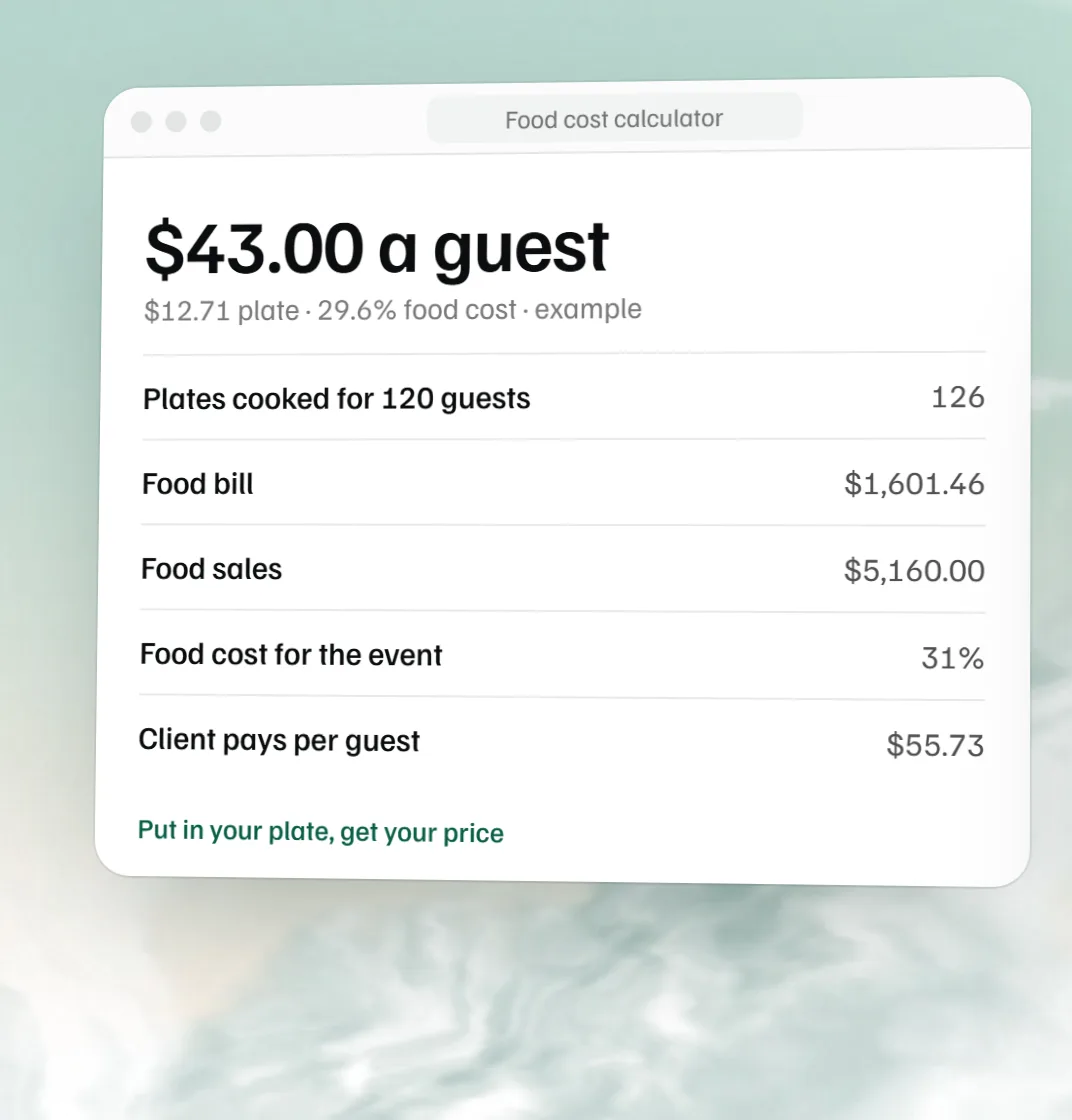
Free food cost calculator: a worked example
This is the plate the calculator opens with. The dish, the pack prices and the event are made up to show the steps, and none of them is a market price.
| Ingredient | Pack | On a plate | Yield | Cost |
|---|---|---|---|---|
| Short ribs | $72 for 10 | 0.75 | 60% | $9.00 |
| Potatoes | $18 for 25 | 0.4 | 80% | $0.36 |
| Green beans | $24 for 10 | 0.25 | 90% | $0.67 |
| Salad, per portion | $32 for 30 | 1 | 100% | $1.07 |
| Roll and butter | $9 for 24 | 1 | 100% | $0.38 |
| Sauce, per portion | $12 for 40 | 1 | 100% | $0.30 |
| Ingredients | $11.77 | |||
| Plate cost, with 8% for extras and waste | $12.71 |
The short ribs show what yield does. They cost $7.20 a pound, and a plate gets three quarters of a pound once cooked. At a 60% yield you buy 1.25 pounds to get there, so the ribs cost $9.00, where the shelf price alone would say $5.40.
At a 30% target the plate needs to sell for $42.37. Rounded up to the next dollar that is $43.00, which is a 29.6% food cost and leaves $30.29 a plate for everything else.
How the food cost calculator works
The calculator uses the formulas in The Culinary Pro’s food cost guide, and adds the event math a restaurant calculator leaves out. Every step is below, with the example plate worked through, so you can check any line by hand.
| Step | Formula | Example |
|---|---|---|
| Cost of one ingredient on the plate | pack price ÷ pack size × amount used ÷ yield | Short ribs: $72 ÷ 10 lb × 0.75 lb ÷ 0.60 = $9.00 |
| Plate cost | sum of the ingredients × (1 + extras %) | $11.77 × 1.08 = $12.71 |
| Menu price at a target | plate cost ÷ target food cost %, rounded up to the step you choose | $12.71 ÷ 0.30 = $42.37, rounded up to $43.00 |
| Food cost % of one plate | plate cost ÷ price × 100 | $12.71 ÷ $43.00 = 29.6% |
| Plates cooked | guests × (1 + overage %), rounded up | 120 × 1.05 = 126 |
| Food bill and food sales | plates cooked × plate cost, and guests billed × price | $1,601.46 and $5,160.00 |
| Food cost % of the event | food bill ÷ food sales × 100 | 31% |
| Service charge | food sales × service charge % | $5,160.00 × 20% = $1,032.00 |
| Tax | (food sales + service charge, if you tax it) × tax % | ($5,160.00 + $1,032.00) × 8% = $495.36 |
| Client pays | food sales + service charge + tax | $6,687.36, or $55.73 a guest |
What each input does
Pack price and pack size describe what you buy, in any unit, as long as the amount on the plate uses the same one. Yield is the share you can serve after trimming and cooking, from 1 to 100 percent. Extras and waste is the Q factor: salt, garnish, condiments, bread and the like. Choose Type a plate cost I already know to skip the ingredients, and the extras box then does nothing, so put everything in the plate cost. Round the price rounds up, never down, so the price can only be at or above the target. If you already charge a price, type it in Or the price I already charge, and everything below the plate, the event food cost and what the client pays, follows that price instead of the target’s.
Edge cases
An ingredient with a pack size of 0 costs nothing, so a half-filled row will not break the total, though it will leave the plate short. A target of 0 gives no price. Overage goes up to 100 percent, service charge to 50 and tax to 25. The calculator keeps your inputs in your browser, so a reload brings them back, and Start again with the example clears them. Nothing is sent anywhere.
What the example shows when you take things out: without the yield column, the plate falls from $12.71 to $8.67. Without the 8% for extras, it is $11.77, and a $43.00 price would look like a 27.4% food cost on a plate that really costs $12.71.
Why a banquet’s food cost runs above the plate’s
A restaurant sells the plates it cooks. A banquet kitchen cooks past the guarantee so a surprise guest still gets dinner, and bills only the guarantee. At 120 guests and 5% over, the kitchen makes 126 plates and the food bill is $1,601.46 where 120 plates would be $1,525.20. The sales don’t change, so the food cost goes from 29.6% to 31%.
The client’s number is different again. At the example’s 20% service charge and 8% tax, the $43.00 dinner costs them $55.73 a guest. Quote the per-guest price and the all-in number together and the final bill won’t surprise anyone.
How cooking past the guarantee moves the event’s food cost
The overage is the one input a restaurant calculator does not have. Same plate, same 120 guests billed, same $43.00 price, only the extra plates change.
| Cooked over the guarantee | Plates cooked | Food bill | Food cost for the event |
|---|---|---|---|
| 0% | 120 | $1,525.20 | 29.6% |
| 5% | 126 | $1,601.46 | 31% |
| 10% | 132 | $1,677.72 | 32.5% |
| 15% | 138 | $1,753.98 | 34% |
A venue that sets the guarantee at the confirmed count and cooks 10 percent over gives up 2.9 points of food cost on this plate. Put the cooking rule in the contract so a client knows what the guarantee covers. The guest count change checklist lists who needs the new count when it moves.
Service charge and sales tax on a banquet
The service charge sits on food sales and leaves the food cost percentage alone, because it is not payment for food. Tax is where states differ, and the Tax the service charge too box exists for that. In the example, taxing the service charge makes tax $495.36 where leaving it out makes it $412.80, and the client pays $6,687.36 instead of $6,604.80.
Three state pages, read November 18, 2026, show how far apart the rules sit:
- New York says a banquet service charge is always subject to sales tax. A mandatory gratuity escapes tax only if it is shown separately, labeled as a gratuity, and every dollar goes to employees. See New York’s guide for caterers.
- California includes a mandatory tip, gratuity or service charge in taxable gross receipts, even when the retailer later pays it to employees. See California’s Publication 115.
- Virginia excludes a mandatory gratuity or service charge up to 20 percent of the meal price and taxes only the excess, and its Tax Commissioner applied that to a country club’s banquet charges. See Ruling 15-10.
That is three states out of fifty, so check your own revenue department. The IRS treats a mandatory charge as a service charge and not a tip, which affects payroll as well as the bill. Service charge vs gratuity explains the difference.
What is a good food cost percentage?
The Culinary Pro gives 20 to 40 percent across the industry, 30 to 35 percent for most sit-down restaurants, and 25 to 30 percent on average for caterers and banquet operations, because guaranteed counts and set menus waste less. Single dishes vary much more, from 10 to 50 percent, which is why a menu is balanced as a whole and why the dollars left on the plate can matter more than the percentage.
For a figure from operators, the National Restaurant Association’s 2024 results put the median for food and non-alcohol beverage costs at 32.0 percent of sales for full-service restaurants and 32.4 percent for limited-service. In its breakdown by size, full-service restaurants with $2 million or more in sales reported 31.0 percent and smaller ones 33.7 percent. Its data comes from more than 900 operators and excludes alcohol.
Those are two sources’ figures, and what you can live with depends on your rent, your labor and how you sell the room. At the example’s plate cost, a 31 percent target prices the plate at $41.00, a 32 percent target at $40.00 and a 33.7 percent target at $38.00, all rounded up to the next dollar. Try your own plate at each target in the table above and compare the dollars left. If you already charge a price, type it in: at $38, the example plate is a 33.4% food cost, and the event comes to 35.1% once the overage is in.
Using the calculator for your kitchen
| If you are | Start with | Watch for |
|---|---|---|
| A caterer or banquet kitchen | Add the ingredients, set the overage you really cook, and use 25 to 30 percent as the first target | Your overage, since it raises the event’s food cost above the plate’s |
| A restaurant with a private dining room | Cost each set menu as one plate, and compare with the 31 to 33.7 percent medians above | Event guarantees and the service charge, which your dining room menu does not have |
| A venue with an in-house kitchen | Cost the plate, then put the price per guest on the BEO and the quote | Labor, which stays out of food cost |
| A venue that resells a caterer’s price | Choose Type a plate cost I already know, and enter the caterer’s per-plate price | Whether the caterer’s price includes their service charge and tax |
| Pricing a bar | Use the free open bar cost calculator | Alcohol has its own cost percentage and sits outside the food figures above |
Common food cost mistakes
- Costing the pack price and ignoring yield. A plate that uses 0.75 lb of cooked ribs from a 60 percent yield needs 1.25 lb bought. The example plate drops from $12.71 to $8.67 without yield.
- Mixing units. If the pack is 10 pounds and the plate uses 8 ounces, convert one of them first. The calculator expects pack size and amount in the same unit.
- Forgetting the small things. The Culinary Pro’s Q factor covers salt, garnish, bread, condiments, disposables and waste, and puts it at about 5 to 10 percent of food cost.
- Judging one dish against the whole menu. The Culinary Pro gives 10 to 50 percent for single items. A menu works when the mix lands on target.
- Costing the guarantee and not the plates cooked. See the overage table above.
- Counting the service charge or tax as food sales. Food cost compares food spend with food sales, so both stay out.
- Pricing from a supplier list that is months old. A costing sheet goes stale as prices change, so re-enter the pack prices when your invoices move.
- Reading the percentage and missing the dollars. A lower percentage on a cheap plate can leave fewer dollars than a higher one on a dear plate.
Calculate food cost for a month
To check the whole kitchen against your sales, use your inventory counts: opening inventory plus purchases minus closing inventory is the food you used. Divide it by food sales for the period. The Culinary Pro says most kitchens count inventory monthly, and weekly or daily when food cost is hard to control.
This gives the cost you actually had. Adding up the plate costs of what you sold gives the cost you should have had, and the gap between the two is waste, over-portioning, spoilage and counting errors. Check it for a month that had several events, and compare it with the event percentages above.
Food cost questions.
What is the formula for food cost percentage?
Food cost percentage = plate cost / menu price x 100. In the example on this page, a $12.71 plate sold for $43.00 is a 29.6% food cost.
How do you calculate plate cost?
Add up what each ingredient on the plate costs you. For each one, divide the pack price by the pack size to get the price per unit, multiply by the amount on the plate, and divide by the yield, the share left after trimming and cooking. Then add a small percentage for extras such as garnish, condiments and waste.
How do you price a menu from food cost?
Divide the plate cost by your target food cost percentage. A $12.71 plate at 30% is $42.37. Most people then round up to a price that reads well, which is what the rounding box does.
What is a good food cost percentage for catering?
The Culinary Pro puts caterers and banquet operations at about 25 to 30 percent on average, because guaranteed counts and set menus cut waste, and most sit-down restaurants at 30 to 35 percent. Treat those as a place to start, since your rent, labor and menu decide what you can live with.
What is a Q factor in food cost?
The Q factor is the cost of the small things on and around a plate that nobody counts one by one: salt, garnish, bread and butter, condiments, and waste. The Culinary Pro says it usually runs about 5 to 10 percent of the food cost. The Extras box adds it.
How much extra food should a banquet cook over the guarantee?
There is no standard figure, so use your own. Put your overage in the calculator and it shows the real food cost for the event: more plates cooked over the same sales. Write the number into your contract so the client knows what the guarantee covers.
Does the service charge count toward food cost?
No. Food cost compares what you spend on food with what you charge for food. The calculator works out the service charge and tax so you can see what the client pays, and leaves both out of the percentage.
Does food cost include labor?
No. Food cost is ingredients only. Food plus labor is usually called prime cost. To price the labor for an event, use the free event staffing calculator, which gives the crew, their hours and the cost at your rates.
How do you calculate food cost for a month?
Opening inventory plus purchases minus closing inventory, divided by food sales. With $8,000.00 on the shelves at the start, $30,000.00 bought, $7,000.00 left and $100,000.00 in food sales, the food used is $31,000.00 and the food cost is 31%.
How do you calculate food cost for a catered event?
Cost one plate, then multiply by the plates you cook, not the guests you bill. At 120 guests with 5% cooked over the guarantee, the example kitchen makes 126 plates at $12.71, a food bill of $1,601.46. Divide that by the food sales (120 guests at $43.00, or $5,160.00) and the event's food cost is 31%, against 29.6% for one plate.
What is yield percentage in food costing?
Yield is the share of a purchased ingredient you can serve after trimming and cooking. Divide the price per unit by the yield to get the cost of what reaches the plate. In the example, leaving yield out of every ingredient drops the plate from $12.71 to $8.67, which would make a $43.00 plate look like a 20.2% food cost when it is 29.6%.
What food cost percentage do restaurants actually run?
The National Restaurant Association reports a 2024 median for food and non-alcohol beverage costs of 32.0% of sales for full-service restaurants and 32.4% for limited-service. Full-service restaurants with $2 million or more in sales reported 31.0%, and those under $2 million reported 33.7%. The figures come from its Restaurant Operations Data Abstract, which covers more than 900 operators, and they leave alcohol out.
Is a 30 percent food cost good?
It sits at the top of The Culinary Pro's 25 to 30 percent range for caterers and banquets and just under the 31.0 to 33.7 percent medians the National Restaurant Association reports for full-service restaurants. Whether it works for you depends on what is left in dollars after food: at 30%, the example plate leaves $30.29, and at 35% it leaves $24.29.
How do I set a catering price per person from food cost?
Cost the plate, then divide by your target food cost percentage. A $12.71 plate at 30% is $42.37, rounded up to $43.00. Put the price per guest and the all-in number with service charge and tax on the same quote, so the client sees both. The free catering quote template takes the price per guest straight from this calculator.
Do you charge sales tax on a service charge?
It depends on the state. New York taxes a banquet service charge. California includes a mandatory service charge in taxable receipts. Virginia leaves a mandatory service charge or gratuity untaxed up to 20 percent of the meal price and taxes only the excess. The calculator has a box to tax the service charge or not, so match it to your state revenue department's rule.
Does food cost include drinks?
Only non-alcoholic ones, in the National Restaurant Association's measure. Alcohol has its own cost percentage, often called pour cost. This calculator costs food. For a bar, the free open bar cost calculator prices drinks per guest, per drink or on tickets.
Is this food cost calculator free?
Yes, with no account. Your numbers stay in this browser. Nothing is sent anywhere.
Run private events in MyVenueHQ
For restaurants and hotels, MyVenueHQ carries the price onto the booking: per-person menu prices on the banquet event order, a service charge with a choice to tax it, a food and beverage minimum on the room, and the kitchen’s copy of the BEO. See restaurant event software for what it does and what it leaves to your POS. For how much food to order, use the free catering food calculator.
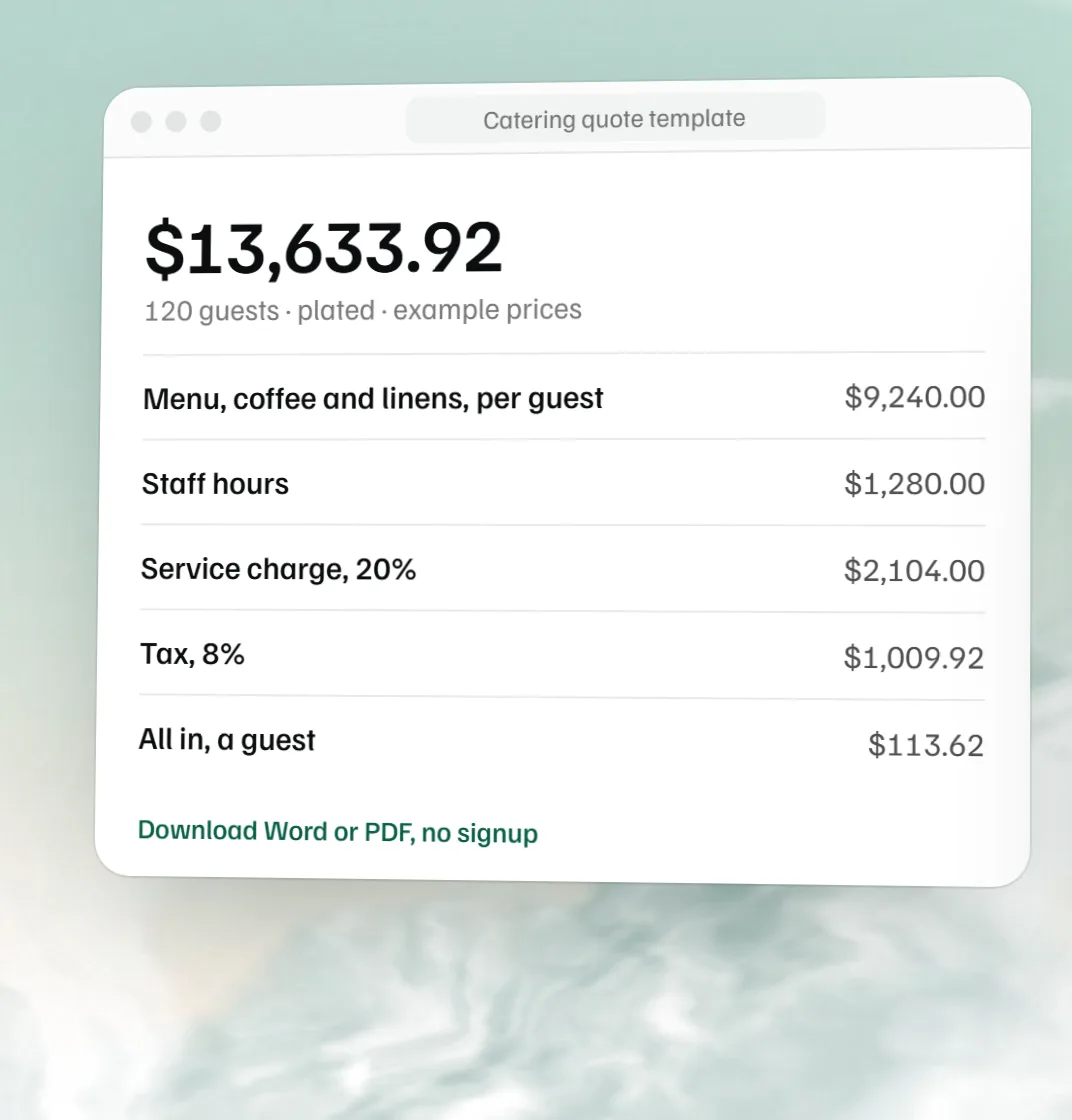 Free catering quote template
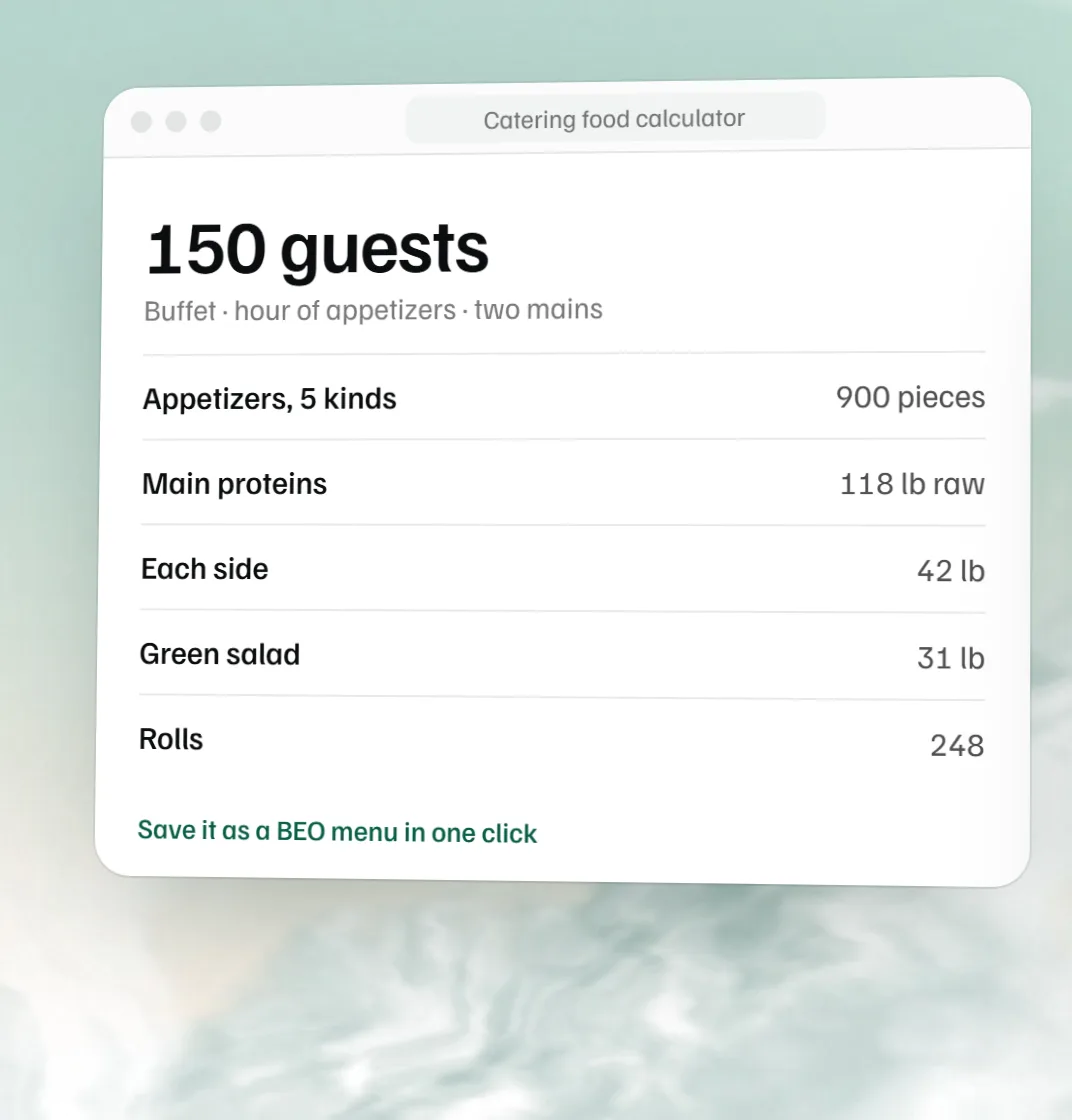 Free catering food calculator
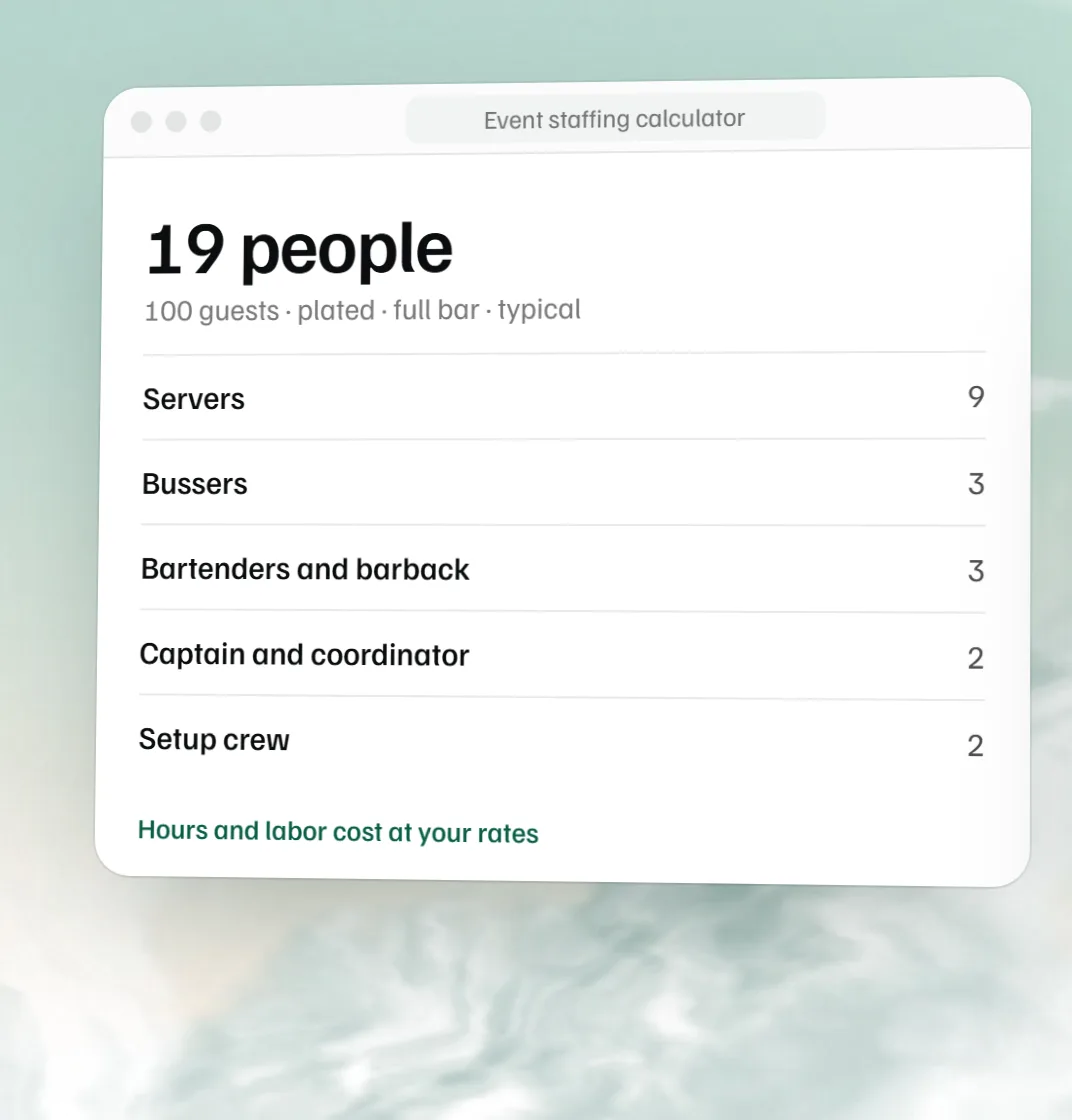 Free event staffing calculator
 Free open bar cost calculator