Free event staffing calculator: how many servers and bartenders you need
This free event staffing calculator gives the crew for your guest count, service style and bar, with the hours each role works and the labor cost at your own rates.
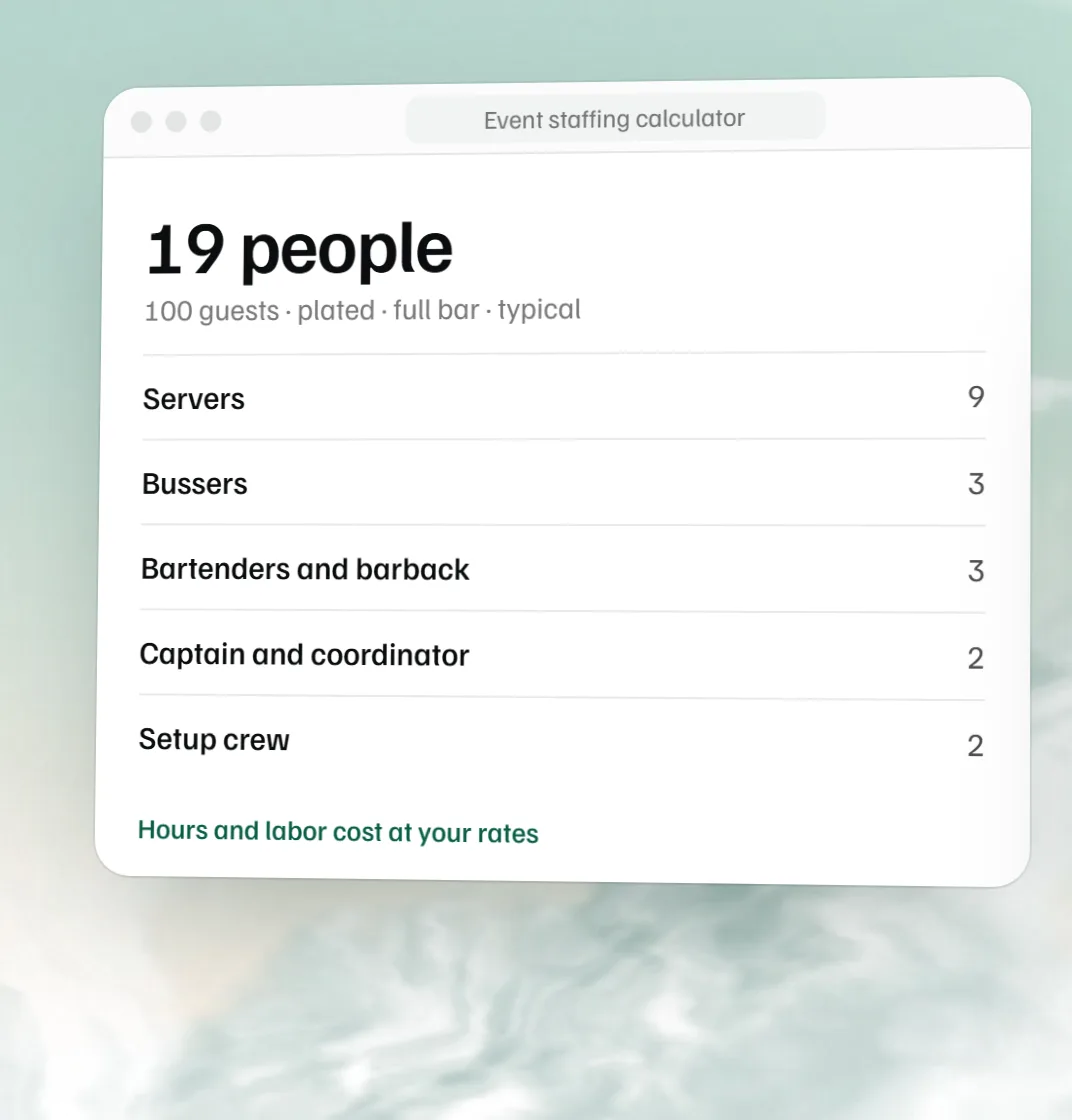
For 100 guests at a plated dinner with a full bar, plan on 9 servers, 3 bussers, 2 bartenders, 1 barback, 1 service captain, 1 coordinator and 2 people on setup. These are typical planning ranges. Nobody sets a standard, and the guides we read disagree, so the page shows you where each number comes from.
19 people
$2,847.00 in labor at your rates, $28.47 a guest.
| Role | People | Hours each | Cost |
|---|---|---|---|
| Servers | 9 | 7.5 | $1,350.00 |
| Bussers | 3 | 7.5 | $405.00 |
| Bartenders | 2 | 7.5 | $300.00 |
| Barbacks | 1 | 7.5 | $135.00 |
| Service captain | 1 | 7.5 | $210.00 |
| Event coordinator | 1 | 9.5 | $285.00 |
| Setup crew | 2 | 4.5 | $162.00 |
Free with no account. Kitchen staff aren’t included, because they depend on the menu.
How many bartenders for 100 guests?
Two for a full bar or for beer and wine, and three for a cocktail-heavy bar. Plan on about one bartender per 50 guests for a full bar, one per 75 for beer and wine, and one per 35 when most guests will order mixed cocktails.
| Guests | Beer and wine | Full bar | Cocktail-heavy |
|---|---|---|---|
| 50 | 1 | 1 | 2 |
| 75 | 1 | 2 | 3 |
| 100 | 2 | 2 | 3 |
| 150 | 2 | 3 | 5 |
| 200 | 3 | 4 | 6 |
Add a barback once you have two bartenders. Bartenders can’t leave the bar, so someone else has to bring the ice, glasses and stock.
How many servers per guest?
About one server per 12 guests for a plated dinner, one per 10 for family style, one per 20 for a buffet or stations, and one per 25 for passed appetizers. A plated dinner needs the most because every hot plate has to reach a table at once. A buffet needs people to restock and clear.
| Guests | Plated | Family style | Buffet | Passed |
|---|---|---|---|---|
| 50 | 5 | 5 | 3 | 2 |
| 75 | 7 | 8 | 4 | 3 |
| 100 | 9 | 10 | 5 | 4 |
| 150 | 13 | 15 | 8 | 6 |
| 200 | 17 | 20 | 10 | 8 |
Move up from typical for several courses, wine service, a long walk from the kitchen or a room on two levels. Move down only with a single course and a short walk from the kitchen.
How the free event staffing calculator works
The calculator turns a guest count into a crew with five rules. It rounds every count up, because half a server is not a person you can book.
- Servers are guests divided by the guests per server for your food service and level of service.
- Bussers are one per three servers.
- Bartenders are guests divided by the guests per bartender for your bar. Choosing no bar gives none. Barbacks are half the bartenders, rounded down, so the first barback appears at two bartenders.
- A service captain joins when servers, bussers, bartenders and barbacks add up to 5 or more.
- One event coordinator is always there. Setup crew is one person per 50 guests, never fewer than 2.
Typing a number in a People box replaces the suggestion for that role only, and the other roles stay as suggested. Typing 0 removes a role. Leave the box empty to go back to the suggestion.
The level of service moves servers, and so bussers, and nothing else. Bartender counts follow the bar you pick, so a heavy cocktail menu needs the cocktail-heavy bar, not the full level of service. The three levels also set the guests per server: for a plated dinner they are 25, 12 and 8.
| Input | What to enter |
|---|---|
| Guests | The count you expect to serve, not the number of invitations. Use your latest RSVP total, and rerun the calculator when it changes. At 0 the crew is empty. |
| Food service | The style that puts the most staff on the floor. If passed appetizers run into a plated dinner, pick plated and ask the caterer whether the same servers move from trays to tables. |
| Bar | Beer and wine, a full bar, or a cocktail-heavy bar. Pick cocktail-heavy when most guests will order mixed drinks. |
| Level of service | Typical for most dinners. Full for formal service, several courses or wine service. Lean only for a single course and a short walk from the kitchen. |
| Hours | Four boxes: how long guests are there, how long the room takes to set, how long floor staff work before the doors open, and how long clearing takes. Include the time you pay for, not the time on the invitation. |
| People and $ an hour | Leave People empty to use the suggestion. Replace every example rate with what you pay. |
| Taxes or agency markup | A percent added to all wages. Leave it at 0 if your rates already include it. |
Event staffing examples with real numbers
Each row is the calculator run at the example hourly rates, with nothing added on top. Your rates will change the dollars, and the crew counts stay the same.
| Event | Crew | People | Labor | A guest |
|---|---|---|---|---|
| 100 guests, plated, full bar, typical | 9 servers, 3 bussers, 2 bartenders, 1 barback, 1 service captain, 1 event coordinator, 2 setup crew | 19 | $2,847.00 | $28.47 |
| The same night, lean | 4 servers, 2 bussers, 2 bartenders, 1 barback, 1 service captain, 1 event coordinator, 2 setup crew | 13 | $1,962.00 | $19.62 |
| The same night, full service | 13 servers, 5 bussers, 2 bartenders, 1 barback, 1 service captain, 1 event coordinator, 2 setup crew | 25 | $3,717.00 | $37.17 |
| 150 guests, buffet, beer and wine, 4 hours | 8 servers, 3 bussers, 2 bartenders, 1 barback, 1 service captain, 1 event coordinator, 3 setup crew | 19 | $2,172.00 | $14.48 |
| 60 guests, passed appetizers, cocktail-heavy bar, 3 hours | 3 servers, 1 busser, 2 bartenders, 1 barback, 1 service captain, 1 event coordinator, 2 setup crew | 11 | $1,108.00 | $18.47 |
| 30 guests, plated, beer and wine | 3 servers, 1 busser, 1 bartender, 1 service captain, 1 event coordinator, 2 setup crew | 9 | $1,392.00 | $46.40 |
Lean to full service on the same 100-guest dinner moves the crew from 13 to 25 people and the labor from $1,962.00 to $3,717.00. Servers and bussers account for all of it: 4 and 2 at lean, 13 and 5 at full.
Small events cost more a guest because three roles don’t shrink with the guest count. At 30 guests the captain, coordinator and setup crew come to $657.00 of the $1,392.00, so a guest costs $46.40 against $28.47 at 100. If the caterer’s lead already runs your small event, type 0 for the captain or the coordinator.
Agency markups change the total more than any ratio does. Breakroom’s guide puts them at 40 to 60 percent above the hourly rate. Put 50 in the markup box and the 100-guest night goes from $2,847.00 to $4,270.50, or $42.71 a guest.
Adjust staffing for your venue and event type
The ratios assume a compact room and a normal menu. The guides we read name these reasons to change them. The calculator has no box for any of them, so type the new count in the People box.
| Situation | What the guide says | In the calculator |
|---|---|---|
| Several floors, separate service zones or a long walk from the kitchen | Breakroom adds 15 percent more staff. Climb the Ladder says sprawling and multi-floor venues need more than a compact room. | For the 19-person example, 15 percent more is about 22 people. Raise servers and bussers first. |
| Formal service, several courses or wine service | Climb the Ladder uses 1 server per 8 guests for high-end plated service. FAUR uses the same for VIP plated service, and 1 per 20 for VIP passed appetizers. | Choose Full service. |
| Many elderly guests or young children | Climb the Ladder says these guests may need extra assistance staff. | Add servers for those tables. |
| A long event or a heavy-drinking crowd | On the Fly Tapsters adds bartenders beyond the standard ratio for events over 4 hours or with high alcohol consumption. | Choose the cocktail-heavy bar, or type a higher bartender count. |
| Cocktail hour that hands over to dinner | Climb the Ladder says transitions can need staggered staffing or a larger crew at the start. | Plan the floor team for the dinner and check the first hour with the caterer. |
| Outdoor, tented or rental-heavy events | FAUR suggests a dedicated setup and breakdown crew for larger, outdoor or rental-heavy events and gives no ratio. | Time your own crew on the room, then type the count. |
| More than 100 guests, several rooms or VIPs | FAUR adds more event managers for events over 100 guests, multi-room venues and VIP events. | Type 2 or more for the coordinator. |
| Food cooked or carved on site | FAUR recommends a chef or kitchen lead. Breakroom gives 3 kitchen staff per 50 guests for plated service. | Kitchen staff are not in the calculator. Take the number from your caterer or chef. |
If the caterer supplies the staff, the ratio in the catering contract is the one that counts. Use the calculator to check that number before you sign. The free catering food calculator sizes the food for the same guest count, and the free venue capacity calculator checks how many guests the room holds.
Free event staffing calculator: where the ratios come from
We found no regulator or trade body that publishes staffing ratios for events, so we read the guides that rank for these questions and set the three levels from what they say. Guests per server or bartender:
| Guide | Plated | Buffet | Passed | Bar |
|---|---|---|---|---|
| Climb the Ladder | 10 to 12, formal 8 | 15 to 20 | 20 to 25 | Beer and wine 50, full 35 |
| Breakroom | 10 to 12 | 1 per 3 chafing dishes | 25 | Full 50, beer and wine 60 to 80, cocktail-heavy 30 to 40 |
| Qwick | 25, as a minimum | 1 per 3 dishes | 25 | 50 |
| On the Fly Tapsters | 10, family style 10 | 1 per 2 chafing dishes | 35 | 50 |
| FAUR Event Staffing | 5 to 8 | 35 to 50 | 35 to 50 | Light 75 to 100, cocktails 35 to 50 |
| Liveforce, a UK agency | 14, premium 11, casual 18 | 25, premium 20 | Full 50, beer and wine 75, cocktail-led 40 |
Typical is where most of them land. Lean is the loosest figure a guide stands behind, and full is the tightest mainstream one. We left out FAUR’s 5 to 8 for plated service as an outlier, because it sits far from the rest. Breakroom also quotes one server per 32 guests as an industry average for every style. We left that out too, because one number for all styles sits far from every style-specific figure in the table. Bartenders at one per 50 and one per 75 are the same figures our free wedding alcohol calculator uses. Tapsters’ blog gives one per 75 for a limited bar, and Liveforce gives 75 for beer and wine.
The rest follows from those counts. Bussers are one per three servers (Breakroom and Liveforce; Climb the Ladder says two to three). Barbacks are one per two bartenders (Qwick). A service captain joins at five floor staff (Breakroom; FAUR adds a server lead at five servers). One coordinator leads each event whatever the guest count, as Tapsters’ guide says of its event manager. Family style has one published figure, Tapsters’ one per ten, so lean and full on either side of it are our own judgement, and setup crew has no published ratio at all, so one per 50 guests with a minimum of two is a starting number.
Liveforce is a UK agency and its security and wage figures follow UK rules, so we use only its guest-to-staff ratios.
How the hours and labor cost work
Floor staff are paid from before the doors open until the room is clear: 1 + 5 + 1.5 = 7.5 hours in the example. The setup crew works the setup and the breakdown. The coordinator is there for all of it. Each role’s cost is people times hours times your rate, and the percent box adds payroll taxes or an agency’s markup on top.
At the example rates the night comes to $2,847.00, or $28.47 a guest. Those rates are made up, so type yours before you trust the number. Tips and service charges are not in it. The service charge versus gratuity guide covers how they differ.
Overtime
The calculator pays every hour at the rate you type and counts one event. Check two rules before you trust the total. Federal law requires time and a half for hours over 40 in a workweek and has no daily rule (US Department of Labor, Fact Sheet 23, read November 18, 2026). So add the hours of anyone who works another shift that week.
California adds a daily rule: hours past 8 in a workday are paid at 1.5 times the regular rate, and hours past 12 at double (California Labor Commissioner’s Office, read November 18, 2026). In the example the coordinator works 9.5 hours at $30.00 an hour. The calculator shows $285.00. Under the California rule it is $307.50. Other states and cities have their own rules, so check yours.
Common staffing mistakes
- Using the invitation count. Staff to the guests who will be there, and rerun the calculator when the RSVP total moves. The guest count change checklist lists what else shifts with it.
- Counting the floor only. The captain, coordinator and setup crew are paid people too, and they are $657.00 of the $2,847.00 in the 100-guest example.
- Paying only for the event. Floor staff are on the clock before the doors open and until the room is clear, so the 5-hour event in the example is 7.5 paid hours.
- Planning for nobody to cancel. Breakroom says to expect 10 to 15 percent no-shows among temporary food service staff, and Liveforce keeps standby staff of about 10 percent of the core team. For the example crew that is about 2 extra people on call.
- Trusting the setup number. No guide publishes a ratio for setup crew, so time a crew on your own room.
- Cutting servers on a plated dinner. Tapsters’ guide warns that too few servers mean cold food and long waits.
- Staffing a heavy bar like a beer and wine bar. For 100 guests the calculator gives 2 bartenders for a full bar and 3 for a cocktail-heavy one.
Staffing questions.
How many bartenders do I need for 100 guests?
Two for a full bar, at about one per 50 guests. Two for beer and wine as well, since 100 is more than one bartender can cover at one per 75. Three for a cocktail-heavy bar, at about one per 35.
How many bartenders for 50 guests?
One for beer and wine or a full bar, and 2 if most guests will order mixed cocktails.
How many bartenders for 75 guests?
One for beer and wine, 2 for a full bar, and 3 for a cocktail-heavy bar.
How many bartenders for 150 guests?
2 for beer and wine, 3 for a full bar, and 5 for a cocktail-heavy bar.
How many bartenders for 200 guests?
3 for beer and wine, 4 for a full bar, and 6 for a cocktail-heavy bar.
How many servers per guest do I need?
About one per 12 guests for a plated dinner, one per 10 for family style, one per 20 for a buffet and one per 25 for passed appetizers. These are typical planning ranges from staffing guides, and the guides disagree, so use them as a place to start.
How many servers for 100 guests?
9 for a plated dinner, 10 for family style, 5 for a buffet and 4 for passed appetizers. A formal plated dinner at one per 8 needs 13, and the leanest figure a guide gives, one per 25 for a single course, is 4.
How many staff do I need for a wedding with 100 guests?
For a plated dinner with a full bar at the typical level, the calculator gives 19 people: 9 servers, 3 bussers, 2 bartenders, 1 barback, 1 service captain, 1 event coordinator, 2 setup crew. 16 of them work the floor and the bar. The rest are the coordinator and the setup crew.
How many staff do I need for 150 guests?
For a plated dinner with a full bar at the typical level, 27 people: 13 servers, 5 bussers, 3 bartenders, 1 barback, 1 service captain, 1 event coordinator, 3 setup crew. A buffet with beer and wine needs fewer, 19 people in the example above.
How many servers for 50 guests?
5 for a plated dinner, 5 for family style, 3 for a buffet and 2 for passed appetizers, at the typical level.
How many waiters per table?
At the typical level for a plated dinner, one server covers 12 guests, which is a table and a half of 8. Qwick’s minimum is one server per 25 guests, about 3 tables of 8. Climb the Ladder’s high-end figure of one per 8 is one server per table of 8.
How many servers does a buffet need?
Buffet guides count dishes as well as guests. Qwick and Breakroom use one server or runner per 3 dishes, and Tapsters uses one attendant per 2 chafing dishes. By guest count, the calculator uses one per 20 at the typical level, which is 5 servers for 100 guests. Bussers are still needed for seated guests.
Should I plan extra staff for no-shows?
Yes, if you use temporary staff. Breakroom puts food service no-shows at 10 to 15 percent, and Liveforce keeps standby staff of about 10 percent. The calculator does not add them. For the 19-person example that is about 2 people on call.
Does overtime apply to event staff?
Federal law requires time and a half over 40 hours in a workweek. California also pays time and a half after 8 hours in a day and double time after 12. Other states differ, so check yours. The calculator pays every hour at the rate you type.
Do I need a barback?
Once you have two bartenders, plan on one. Bartenders can’t leave the bar, so someone has to bring ice, glasses and stock. Qwick’s guide says one barback for every two bartenders, and the calculator uses that.
How many people do I need to set up an event?
We found no published ratio for setup crew, so the calculator starts at one person per 50 guests with a minimum of two, and that is our starting number and nothing firmer. Time your own crew on a room you know, then type the count you trust.
How many kitchen staff does an event need?
It depends on the menu, so the calculator leaves the kitchen out. As a reference, Breakroom’s guide gives three kitchen staff per 50 guests for plated service.
Does the labor cost include taxes and tips?
Only if you add them. The rates are yours, and the percent box adds payroll taxes or an agency’s markup on top of wages. Tips and service charges are not in the number. Breakroom’s guide puts agency markups at 40 to 60 percent above the hourly rate, so ask for the real figure if you use an agency.
Is the event staffing calculator free?
Yes, with no account. Your numbers stay in this browser. Nothing is sent anywhere.
Put the crew on the event in MyVenueHQ
MyVenueHQ keeps the staffing with the booking. Open an event, go to Plan, then Staffing, and add each person with a name, a role, shift start and end and a rate. Mark each one confirmed or declined. The total adds up the rates you type, so enter what each person is paid for the shift: this calculator’s hours times the hourly rate. It is a list for that one event, not a rota across events, and nobody is emailed. The banquet event order has its own staffing section, with a role, a count and notes on each line. For a blank BEO you can fill in now, use the free BEO template.
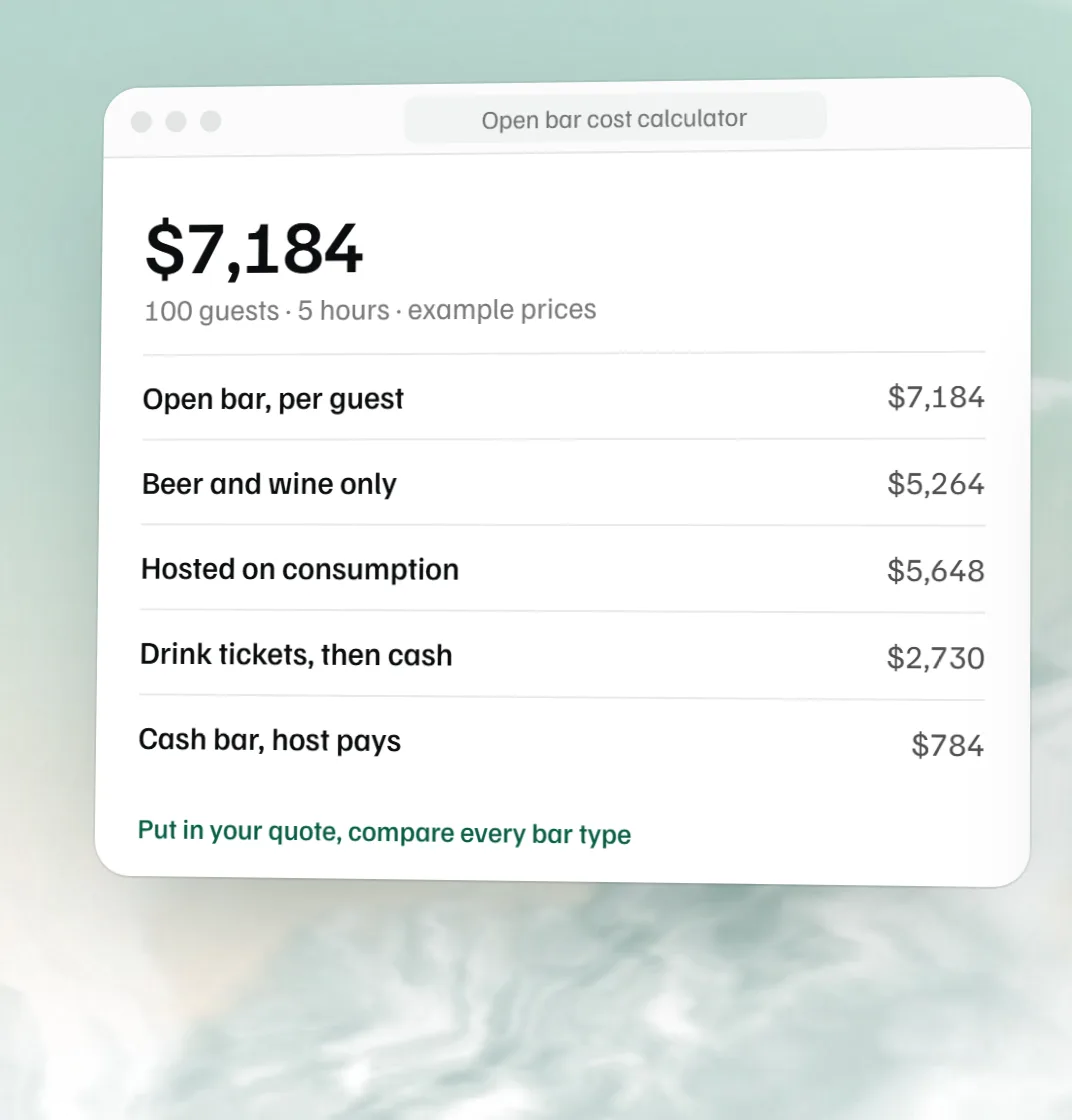 Free open bar cost calculator
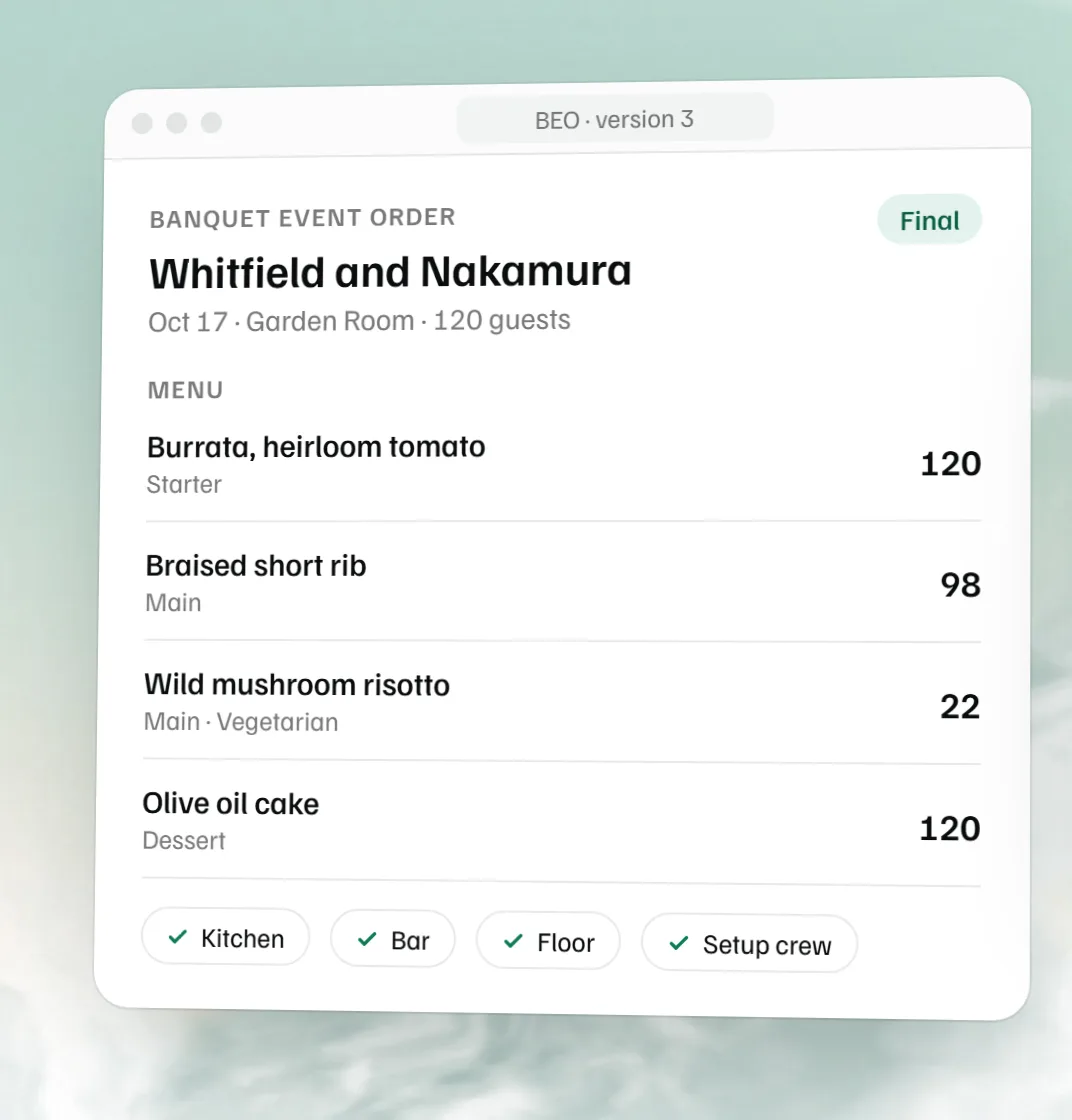 Free BEO template
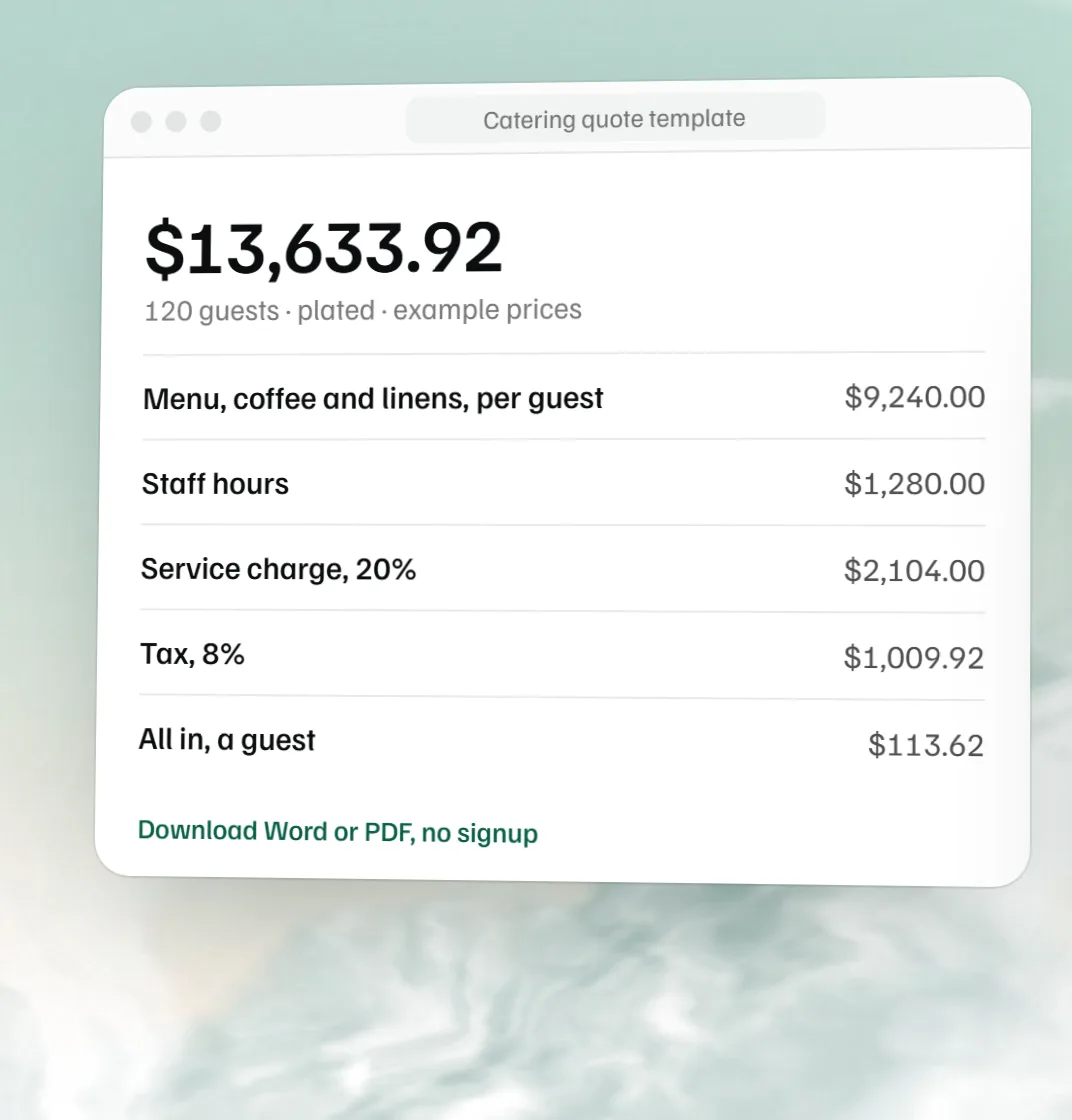 Free catering quote template
 Free food cost calculator